Dundee 2 Aberdeen 1
Another clever set-piece – one designed to catch the Aberdeen defence off-guard – and a customary strike from David Clarkson gave Dundee the victory at Dens Park in a pulsating Scottish Cup tie. It was, however, the man-of-the-match performance of Aberdeen’s Jonny Hayes that caught the eye.
Aberdeen seemed to confuse their opponents from the off. Hayes lined up at kick-off as if he was going to operate on the left but, as soon as the game started, drifted into one of the holding midfield positions in a 4-2-3-1. The Dons immediately created a chance from kick-off and were inches away from taking the lead. This is an unfamiliar role for the former Inverness star but he slotted in seamlessly, dropping deep to collect the ball from the Aberdeen defenders before launching attacks.
But this was by no means the full extent of Hayes’s contribution. In a tactic reminiscent of Guardolia’s Bayern Munich full backs arcing into the centre of the pitch to become holding midfielders when their side have possession, Hayes performed what was almost the inverse: bursting up towards the left wing when Niall McGinn drifted into central areas.
The Aberdeen equaliser came when Hayes collected the ball in the middle of the park and drove at the Dundee defence before teeing up McGinn and was also found covering at left-back when required. He even popped up on the right wing in the second half to go on a mazy run down the touchline and again set up a teammate, this time Adam Rooney.
With Aberdeen again chasing an equaliser, now into injury-time, Hayes found McGinn once more, this time with a cross-field pass but the Northern Irish international’s fierce strike forced an incredible save from Scott Bain in the Dundee goal.
Hayes was unfortunate to find himself on the losing team and will no doubt be happy with his individual performance. It will be interesting to see if his manager continues to deploy him as such in the continued absence of Willo Flood and Barry Robson.
Showing posts with label 4-2-3-1. Show all posts
Showing posts with label 4-2-3-1. Show all posts
Saturday, 29 November 2014


Wednesday, 31 August 2011
Can Celtic stick with the same system without Izaguirre?
Last season, Neil Lennon favoured a lopsided 4-4-2 with Kris Commons pushed ahead of what were essentially three central midfielders. Either Scott Brown or Joe Ledley would inhabit a more reserved and tucked in role on the opposite flank to Commons. Moreover, Commons would look to drift inside and occupy the space between the opposition defence and midfield.

The narrow nature of the Celtic midfield was compensated for by the advancement of marauding full-backs, Mark Wilson and Emilio Izaguirre. At one point last season, both would push up the pitch as much as possible – the 2-2 draw in the Scottish Cup at Ibrox last season is a prime example, even if the initial formation in that match differed from the lopsided 4-4-2 – but towards the end of the season, Wilson’s impetus from right-back dissipated somewhat.
4-4-2, and three-band formations more generally, have gone out of fashion with top sides in the past decade, with many clubs now favouring 4-2-3-1, 4-2-1-3 and the like. The position of Commons, along with the front two dovetailing in Lennon’s 4-4-2, gives the formation an implicit fourth band.
This particular deployment of 4-4-2 is nothing new. Kenny Dalglish employed something similar during his first spell as Liverpool manager, and again when manager of Celtic for a brief spell. As pointed out in the embedded article, fielding two out-and-out wingers in a 4-4-2 can be a risky strategy and Lennon himself has resisted such a move on all but a few occasions.
The system has been effective for a few reasons. Firstly, it permits three central midfielders in the line up and, given the quality that Celtic possess in that area of the pitch, allows them to dominate most midfield duos and trios they come up against.
Now with the full-backs pushing on to offer width and Commons given free rein to drift ahead of the midfield, the system permits Lennon to field a strike partnership.
In an article spelling out the demise of the classic goalpoacher, Jonathan Wilson points out that due to the rise of lone-striker systems, top strikers are now expected to blend classic strike partnerships into a hybrid role – be it a Didier Drogba that fuses the target man and finisher roles, or a David Villa that combines the best of the creator and finisher responsibilities.
Unfortunately, in Scottish football there is a dearth of these types of strikers. Nikica Jelavic is one exception and the reason why Rangers will sometimes line up with a lone striker system. Garry O’Connor is another who blurs the target man/finisher boundaries but his quality his waned somewhat since his last spell at Easter Road.
It is no surprise then, that given the lack of this type and quality of striker, that some clubs in the SPL still favour a 4-4-2. David Goodwillie was a further example in Scottish football of a creator-finisher hybrid before his recent transfer to Blackburn Rovers, but his departure has seen Peter Houston move from a lone-striker system to a front pairing of Jon Daly and Johnny Russell (or, more recently, Russell and Lauri Dalla Valle).
Without doubt, Antony Stokes and Gary Hooper are two of the top strikers in the league and are arguably the best partnership. Their link-up play and mutual understanding have seen them terrorise many an SPL defence. However, neither is suited to playing as the sole striker. Instead, Lennon has tended to favour Georgios Samaras when the need to go with one striker arises.
Lennon did experiment with Hooper spearheading a 4-2-3-1 in the recent win over Aberdeen but soon realised its shortcomings due to the personnel at his disposal and quickly switching back to his more familiar 4-4-2. Stokes looks uncomfortable pushed out wide and the knock-on effect is that Hooper becomes isolated.
To sum up, the main benefit of Lennon’s formation is that it allows for a strike partnership without allowing other sides a man advantage, or else allows Celtic to retain a man advantage, in the centre of midfield. Further, the personnel at his disposal rules out any lone striker system, although, admittedly, I know very little about new signing Mohamed Bangura.
The success of the formation last season – Celtic didn’t win the SPL but they amassed a points total worthy of it most other years, won the Scottish Cup and played some of the best football in the SPL – was partly down to the attacking prowess of Izaguirre and the loss of the Honduran to long-term injury has had an adverse affect on the effectiveness of Lennon’s system.
Lennon has since deployed Charlie Mulgrew at left-back. The former Aberdeen defender is comfortable on the ball and possesses a great delivery but lacks the pace and drive that Izaguirre provides. His more reserved approach to that of the Honduran may go some way to explaining why Commons has been less valuable so far this season. More specifically, there is no one bombing beyond him and giving opposition full-backs a dilemma.
Alternatively, Lennon could move one of his right-backs, most likely Mark Wilson or Adam Matthews, over to the left. The problem with this approach is that the overlap would thus become less of a danger to opposition defenders since Wilson or Matthews would find themselves having to cross with their weaker foot or else cut inside on to their stronger side.
Either way, Celtic will miss the attacking threat from left-back that Izaguirre provides. Subsequently, it seems that Celtic are now inviting pressure upon themselves down the flanks. Tic_Tac_Tic reports that the Dundee United full-backs took advantage of the space afforded to them by the Celtic midfield, which left Wilson and Mulgrew exposed.
Either Celtic need to switch to a formation that allows more width from midfield or else look to Adam Matthews or Cha Du-Ri to provide from the right what Izaguirre managed from the left last season. Cha didn’t exactly inspire in the recent win over St. Mirren and although Matthews comes with glowing reports from south of the border, he is still a teenager and has only started two competitive matches this season.
Wilson, the other option at right-back, has fallen out of favour at Celtic Park recently and, as mentioned earlier, doesn’t get forward as much as he did at certain points last season.
So what next for Neil Lennon’s Celtic? Most of their performances this season have been uninspiring and it appears that their formation has lost much of its effectiveness which, it is argued here, is largely down to the loss of Izaguirre and its knock-on effects.
As I write, however, it is transfer deadline day. Celtic could recruit a left-back before the day is out, even if the signing of Dundee United’s Paul Dixon now seems unlikely. If Lennon fails in his bid to bring in an attacking left-back, he will have to tinker with his formation in order to compensate for the loss of the width and drive that Izaguirre provided from that position last season.
Or perhaps Bangura will be the man that allows him to deploy a lone striker system and introduce two wingers to his starting line up.
Wednesday, 8 June 2011
Packing the Midfield
A growing trend during the most recent SPL campaign was for sides to pack the centre of their midfield. This is not to say that teams are now dropping one of their strikers in favour of another midfielder – this has been evident for many years now – rather, sides appear to be starting matches with a narrow midfield four or five.
To put the same point a different way, when 4-4-2 was the default formation, some sides would diverge and set up more defensively by dropping a striker for an extra midfielder, thus moving to a 4-5-1 which still contained two wide players. What is increasingly common now, however, is that teams are setting up in such a way that their line up contains four, sometimes five, central midfielders across two bands.
Liberalisation of the offside law
Since the liberalisation of the offside law in 2005, most teams have reverted to holding a deeper defensive line in order to avoid being caught out by the pace of opposing strikers – this is evidenced by the fact that the number of offsides per match has actually fallen significantly in recent years. Consequently, the effective playing area has been stretched, leading teams to split their midfield into two bands – one attacking and one defensive – hence the re-emergence of four-band formations. Thus, it is no longer adequate to describe the majority of formations as 4-4-2, 4-5-1 or 4-3-3. 4-4-2 formations are more likely 4-4-1-1 or 4-1-3-2 or something similar; 4-5-1 is more accurately described as, say, 4-2-3-1 (the most popular formation at last year’s World Cup); whereas a more precise notation of 4-3-3 could be either 4-3-1-2 (the default formation in Serie A at the moment) or 4-1-2-3 (the formation used by Barcelona to great effect in recent years).
In each of these formations, there is at least three central midfielders – the 4-4-1-1 contains two holding and one central attacking midfielder, as does the 4-2-3-1, whereas the 4-1-3-2 contains four central midfielders, one deeper-lying than the other three, and the 4-3-2-1 has three holding midfielders and two attacking central midfielders. Although these formations, many of which are lone-striker systems, may appear prima facie more defensive, there is no reason why any should be considered as such. Formations are neutral, it is their implementation that gives them positive and negative characteristics.
Therefore, the title Packing the Midfield is intended to convey that some teams are now squeezing four or five central midfielders across two bands, rather than the more traditional use of the phrase which implied a defensive approach, i.e. when a manager decided to drop a striker in favour of another central midfielder with the intention of stifling the midfield area, thus restricting the opportunities of their opponents.
Evidence elsewhere
Before we proceed to the SPL, it is worth pointing out a few examples of formations with four or five central midfielders elsewhere in Europe. The default 4-3-1-2 in Serie A has already been mentioned but even the sides in Italy that do not adopt this formation, most notably Napoli, still make sure there are plenty bodies in central areas. Walter Mazzarri’s favoured formation this season has been 3-4-2-1. Broken down, this formation contains three central defenders; two holding midfielders flanked by two wing-backs; two central attacking midfielders and one striker. This gives the side four central midfielders.
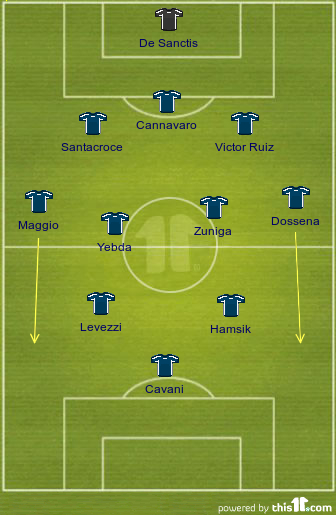
Evidence can also be found in Spain’s La Liga. Villarreal have lined up 4-2-2-2 for the majority of the previous season under Juan Carlos Garrido, a formation that contains two holding midfielders, two central attacking midfielders and two strikers – an upside-down T-shape – whereas recently-crowned champions Barcelona’s fluid 4-1-2-3 contains one holder, two central attacking midfielders and then Lionel Messi in the false 9 role which involves him dropping into the central attacking midfield area, giving his side, in effect, four central midfielders.

SPL examples
The first example, and perhaps the inspiration for this article, was the formations Celtic manager Neil Lennon deployed during the 2-2 draw at Ibrox in February. Celtic began the match in a lopsided 4-5-1 with Kris Commons wide left and Scott Brown in his, now familiar, tucked-in right sided role. The formation, therefore, contained four central midfielders, with one natural winger further forward.

Rangers dominated the early stages and opened the scoring early on, forcing Lennon to switch things around. He subsequently moved Commons into a central position just off Gary Hooper in attack, giving Celtic, in effect, five central midfielders. The four deeper-lying midfielders – now fluid and interchanging – all held central positions and now relied on the full-backs to provide width. The switch saw Celtic dominate the midfield area.

Similar examples of the above include Rangers’ 5-4-1, which also contained a narrow midfield four, first seen in the 2-2 draw away to Sporting Lisbon in the Europa League - the key difference being that Rangers’ midfield tended to be more rigid. As well as this, Derek McInnes has been known to line up St. Johnstone with a fluid central midfield four, usually in the form of three out-and-out central midfielders and Liam Craig in a tucked-in left-sided role.
Colin Calderwood has favoured a 4-1-3-2 formation for the most part since taking over as Hibernian manager towards the end of last year. The 4-1-3-2 involves Victor Palsson sitting just ahead of the defence as a deep-lying playmaker and is usually accompanied by three central midfielders just ahead of him, although there have been one or two occasions where one of the three is naturally a winger and thus has a tendency to drift wide.

In all of the above examples, the sides rely on their full-backs or wing-backs to advance and provide width. One example that does not necessarily involve pushing the full-backs on can be found with St. Mirren. Danny Lennon set his side up in a 4-3-2-1, or Christmas tree formation, during a recent trip to Ibrox which contained two attacking midfielders – Paul McGowan and Aaron Mooy- just ahead of three more industrious central midfielders – Paddy Cregg, Jim Goodwin and Steven Thomson – giving them five players in central midfield positions. The tactic worked for the most part as St. Mirren reduced the home side to few clear-cut chances and in the end narrowly lost the match to a second half Steven Whittaker penalty.
Drifting wingers
Evidence of sides packing the midfield area can also be found with a few clubs who tend to field players as a drifting winger or winger-cum-second-striker, that is, a player who starts in a wide position but who has a tendency, sometimes a compulsion, to drift into central areas. Perhaps the player in the SPL to play this role to the greatest effect is Steven Naismith of Rangers, although he usually executes this as part of a 4-4-2, giving Rangers a third central midfielder.
We would have to look to Scotland’s recent victory over Wales to find an example of three central midfielders being given extra help in that area by Naismith as a drifting winger. It is notable that Naismith, and Scotland as a whole, were not nearly as effective when Naismith was deployed as a second striker behind Kenny Miller in the following match against the Republic of Ireland.
Where the drifting wingers have caused sides to have, in effect, more than three central midfield players can be found in the following examples. Even though we have already discussed Celtic above, the formation mentioned was pretty much a one off as Lennon seemed to favour a two-striker formation most of the time. This did not detract from his desire to pack the midfield, however. For the second half of the season, Lennon’s most used formation was a lopsided 4-4-2. The starting positions included two holders – for example, Joe Ledley and Beram Kayal – with Scott Brown again in a tucked-in, right-sided role and Kris Commons on the left wing and more advanced. Commons, however, would often drift inside to central areas to collect the ball and link play between the Celtic midfield and attack. The movement of Commons meant that at many points during matches, Celtic had four players in central midfield positions.

At one point later in the season it appeared that Celtic were moving towards more of a 4-2-2-2, bearing some similarities to that of Villarreal mentioned earlier, with Brown slightly more advanced than usual and Commons pretty much as a central attacking midfielder. However, this formation didn’t last long and Lennon soon reverted back to the lopsided 4-4-2

Once Danny Swanson and Craig Conway returned from injury, Peter Houston was able to revert his Dundee United side back to his favoured 4-5-1-cum-4-3-3 formation with a V-shaped midfield. In this set up, Swanson is pretty much given free reign to drift all over the park. He will occasionally pop up on the opposite wing but spends a lot of time coming inside to occupy the area behind David Goodwillie and sometimes even drops as deep as the centre circle to collect the ball and start off attacks. It is also worth noting that Houston has also been willing to switch to a Christmas tree formation during matches, in effect, giving his side five central midfielders.

David Obua did something similar in Hearts’ 4-0 defeat to Rangers last month, albeit from a deeper starting position. It seems from the above that even though the starting positions of most sides suggests X amount of midfielders, a growing number of managers are instructing one of their wide players to either play a tucked in role, in other words a halfway house between wide and a central midfielder, or else as a drifting winger in order to give their side more bodies in the centre of the pitch while retaining some sort of width from midfield.
Reasons
One reason for the loading of central midfield areas has already been alluded to. This area of the pitch is often of paramount importance as winning the midfield battle is frequently the difference between victory and defeat. Having an extra man in the centre of midfield gives a side more chance of dominating possession and this is one of the reasons why 4-4-2, in its traditional form, has largely disappeared. The move away from 4-4-2 to two band formations has ultimately been aided by the liberalisation of the offside law which creates more space in central midfield areas and this, naturally, leads to more players being positioned where there is more space.
Furthermore, squeezing more players into central midfield positions has a positive effect on both the defensive and attacking capabilities of the side. Not only do the two or three holding midfielders offer their defence more protection, meaning that it is easier to win the ball, but when the ball is eventually won there are more passing options around the player in possession.
One further reason, related to the point in the previous paragraph, regards the apparent rise of strikerless formations in recent years. Craig Levein was, perhaps justifiably, lambasted for experimenting with a 4-6-0 in a Euro 2012 qualifier last year although a number of top teams have effectively employed such a tactic, most notably Barcelona, Manchester United and Roma. One of the thoughts behind this, which is related to our more general point that sides are deploying more central midfielders, is that once the ball is won it is more effective – or from the perspective of the opposition, more difficult – to have midfielders running at and beyond defenders rather than having strikers pushed high up the pitch with their back to goal.
So even though there seems to be little or no examples of a side in the SPL that doesn’t line up in four bands, it seems now that there are many examples of the two midfield bands becoming increasingly populated, be it from fielding more actual central midfielders or else by deploying wingers or wide midfielders who drift inside. Overall it seems that packing the midfield, more specifically the centre of midfield, is on the rise although not in the traditional sense and not necessarily with the aim of moving towards more negative football.
Wednesday, 6 April 2011
Five things to take from Sunday's Edinburgh derby
In what was surely the final Edinburgh derby of the season, ten-man Hearts came from behind to salvage a well deserved point. Hibernian extended their unbeaten run to seven matches although will be disappointed not to have taken all three points.

Ryan Stevenson can play as a striker, as long as you don’t expect him to win an aerial battle
It was surprising to see Stevenson again take up a striking role for Hearts. The former Ayr United midfielder was deployed as an auxiliary striker in the 1-0 win over Rangers in January but looked out of his depth on that occasion. The difference on Sunday was that he was joined in attack by Stephen Elliott in a 4-4-2/4-2-4 formation.
Furthermore, and again unlike during the victory over Rangers, the strategy of Hearts was to move the ball quickly towards Andy Driver and David Templeton, who took up advanced positions on either wing, and not to hit long, direct passes towards the edge of the box. Hearts have struggled to fill the void left by long-term absentee Kevin Kyle, especially in matches where they have a tendency to, or are forced to play long ball.
Stevenson opened the scoring in the first half with a control and finish that any seasoned SPL striker would be proud of. Not only this, he also dropped deep earlier in the move to link play. As well as this, Stevenson relentlessly closed down the Hibs defence and was one of the start performers on the day.
Stephen Elliott is definitely better with a strike partner
Relatedly, the Hearts performance in the first thirty minutes showed that Elliott is much better when not used as a lone-striker. Stevenson’s presence in attack and the advanced positions taken up by Driver and Templeton meant that Hearts effectively lined up man-for-man against the Hibs defence. Consequently, Elliott was afforded more space than usual and his movement between the lines and the inside channels caused the Hibs defenders many problems. Early in the match he found himself on the end of a few well worked moves, one of which he should have scored, another that should have earned his side a penalty.
After the red card, Elliott was moved to the right side of midfield in a 4-4-1 formation. He continued to perform impressively, although Hearts inevitably created less and most of his work was defensive in nature. He was left unmarked for the equalising goal after some poor set-piece defending from the home side yet finished well.
Hibs failed to take advantage of their numerical advantage in midfield
Hibs started the match with a numerical advantage in central midfield. Even before the ordering off of Marius Zaliukas, there were times when Hibs had a 3v2, and sometimes even a 4v2, advantage in the centre of the pitch. Despite this, and perhaps counterintuitively, Hearts dominated. Jim Jefferies’s side started with two deep-lying central midfielders and defended the area while avoiding playing through it.
Therefore, on paper at least, Victor Palsson, Liam Miller and Matt Thornhill should have dominated the central areas. However, they failed stamp their authority on the match until the second half when Hearts were down to ten men and were more inclined to sit nine men behind the ball.
Thus, the three main reasons for Hibs failing to dominate the midfield early in the match were: (i) they failed play the ball through the area effectively, (ii) Hearts defended the area well and avoided playing through it themselves and, (iii) Elliot and Stevenson showed a willingness to defend from the front and press Hibs high up the pitch. There was no such willingness from the Hibs strikers.
Hibs looked better with wide men in advanced areas
Admittedly it is more difficult to judge when possessing a numerical advantage, however, Hibs were much more dangerous in the second half when Ricardo Vaz Te was introduced in place of Martin Scott. Hibs had started in their familiar 4-1-3-2 formation (although it appeared to be more like a 4-4-2 diamond formation with Thornhill more advanced than Miller has been in the same role recently) but moved to a more expansive 4-2-3-1 after the break. Vaz Te took up a right-wing role, with Derek Riordan moving to the left in a fluid front five and Hibs instantly improved.
The switch meant that Hibs no longer relied solely on their full-backs for width. Callum Booth managed to get forward for most of the match from left-back whereas Richie Towell struggled to do the same on the opposite flank. Not until the second half did Richie Towell regularly find himself in possession in an advanced area, although this was partially down to Driver’s frequent drifting into the centre, leaving plenty of space on that side.
What should have been the winning goal for Hibs came from the right-hand side and involved Towell. By this time he was linking up with Wotherspoon down the right and Vaz Te had moved to just off Akpo Sodje in attack. With players like this available to Calderwood, a 4-2-3-1 or similar variant certainly an option for Hibs.
Hibs will be fine under Colin Calderwood
Much doubt was cast over Calderwood after a terrible run of results, including a Scottish Cup exit at the hands of Ayr United shortly after taking over. He inherited a side low in confidence before making six new signings in January. He has now not only steadied the ship, but also has everyone involved with the club looking up rather than down the table.
Their recent run, although admirable, had until Sunday come against teams mostly from the bottom six. Seven games without defeat, including matches against Kilmarnock and Hearts, looks a lot more impressive. To expect to end the season in the top six would be overly-optimistic, although they should have no problems finishing in the top half of the table next season.
Calderwood was appointed at Easter Road with an impressive record in the English lower leagues behind him. Those who prematurely, even in the merry-go-round era of football management, called for Calderwood to be relieved of his duties after two wins in his first fourteen matches in charge must surely now recognise his pedigree. In the space of a few months and with very little money, he carried out effective business in a notoriously difficult January transfer market. He has now turned a side fighting relegation into one that has now reached the form the supporters expect.
Sunday, 3 April 2011
Hibernian v Hearts preview
Tom Hill from The Scottish Football Blog and I wote separate pieces for today's Edinburgh Derby. The first part, written by Tom, is from the Hibs perspective. The second part was written by myself. My secret is out.
Please follow the link above and check out Tom's blog.
Edinburgh Derby Preview: A Hibs Perspective
Colin Calderwood recently the had pleasure of meeting me for the first time.
Truth be told, I’d possibly over indulged.
Drink beer and wine you'll feel fine. But when you drink wine and beer you'll feel queer.
Quite.
So my attempts to congratulate him on Hibs’ recent run of form possibly sounded a little like:
“See me, Col, I’m a bit pished.”
But he’s a very approachable chap, smiled benignly and said that he had much work still to do.
And indeed he does.
His tenure at Hibs has been short but not without challenges. He took over a failing team and it continued to fail.
Faced with both a bleak league table and a squad that clearly did not impress him, he then had to use the transfer window to halt a decline that was beginning to look perilously like a manifesto for relegation.
He pulled that off. Hibs have won five of their last six games, only a draw at St Johnstone denying them 18 points from 18.
That’s impressive. More so when we consider that this has been done with a team that bears little resemblance to the one John Hughes started the season with.
It’s quite unusual in Scottish football for a manager to scrape together such a transformation in the January transfer window. It’s unheard of at Easter Road.
So Calderwood has laid aside his faltering start, begun to sweep out the mess left by his predecessor and taken some steps towards convincing the fans that here is a manager who can prosper at a club that has recently shown a remarkable intolerance to any perceived weaknesses in the dugout.
As a Hibs fan all of this heartens me.
And that should mean I’m feeling reasonably confident about Sunday’s derby.
Well, to an extent.
Partly my trepidation comes from too much experience of Hearts-ache. Partly it’s because I am, by nature, predisposed to take a bleak view of the world and everyone and everything that’s in it.
Those are general, lasting reasons for a sense of pre-derby misgiving.
There are also more pressing concerns for Sunday.
The fact that Hibs haven’t played a competitive game since March 5th means, at the very least, they are going into this one short of match practice or any real guide to their form. That could either be a good thing or a bad thing.
The six game undefeated run has been welcome, it’s been enjoyable and calmed talk of a club in crisis.
But Kilmarnock are the highest placed side to have been beaten. There’s been no test against the Old Firm, no measure of progress against a form team like Dundee United.
A new look side has done well to win so many games as they searched for cohesion and understanding in the squad.
Yet even taking into account the slight halt to Hearts’ progress as they find themselves bogged down in the no man’s land of third place, a derby represents a completely different challenge for Hibs.
They could well prove up to that task but it remains something of a step into the unknown.
Hearts have also won the last four of these clashes and are now undefeated in six. We have to go back to Derek Riordan’s late penalty at Tynecastle in May 2009 for the last Hibs win.
All of which serves to dampen my ardour for proceedings. And yet...
Certainly I’d be disappointed and a touch surprised if Hibs appear as devoid of intent and purpose as they have done in the previous two clashes this season.
This is, for all that they’re relatively untested, a Hibs team with more edge, more thrust and an added stomach for the fight. Hearts should find more resistance as they attempt to impose themselves on Easter Road.
In Richie Towell and Callum Booth the home side have full backs who are capable of giving Hearts’ midfielders and defence pause for thought. Akpo Sodje gives an added dimension in attack, Derek Riordan retains a certain enigmatic quality.
Victor Palsson’s injury in Iceland’s under-21 clash against England is a concern. He’s become a combative component of a midfield that Calderwood has transformed into a more formidable unit. Here’s a 19 year old who does not look like an Edinburgh derby would give him any reason to be fazed.
It’s a different Hibs, a better Hibs.
All of this leaves me searching for a prediction. Into the mix I must throw Hibs’ improvement, Hearts’ slight slips, Hibs’ inactivity, my own pessimism, Hibs’ new faces and the added pressures and dig of a derby clash.
Which, when processed, means?
I really don’t know. I expect this one to be close. I don’t expect Hearts to be able to dictate the way they did earlier in the season.
These are games that rarely throw up treats for the neutral footballing aesthete. If the sides are more evenly matched then we might find the game turning on an individual contribution, be it a flash of brilliance, an honest mistake or a moment of madness.
And that can make a game something of a lottery.
Which drags me inexorably towards predicting a draw. With the proviso that either team could sneak this one by the odd goal.
Apologies if that’s about as decisive as a tactics talk from John Hughes. But there we have it.
I’m feeling sick with nerves already.
Edinburgh Derby Preview: A Hearts Perspective
After two solid months of nothing but Old Firm matches, attention now turns to Easter Road for Scotland’s real showcase football match. Hearts will be looking to make it five wins in-a-row against their Edinburgh rivals but will surely face a sterner test this time around from a resurgent Hibs team.
Hearts without a number of players
Jim Jefferies is without a number of key players heading into Sunday’s match. Eggert Jonsson and Adrian Mrowiec are suspended; Kevin Kyle, Lee Wallace and Calum Elliot are all out injured, whereas Rudi Skacel, Marius Zaliukas and Suso Santana are doubts. Consequently, Hearts find themselves light in almost every area of the pitch.
Whereas Hibs now have a settled back four, the Hearts defence has chopped and changed in recent weeks. Full-back has proved to be a problem position all season. Ruben Palazuelos has deputised adequately for long-term absentee Lee Wallace at left-back but his services would have been more beneficial in the centre of midfield due to the lack of options there.
Right-back has been more of an issue and with Jonsson suspended, Craig Thomson looks set to start. Although a full-back by trade, Thomson has looked unsteady defensively this season and has shown that his best qualities lie in deliveries into the box, be it from open play or from dead ball situations. He started on the right-wing against Dundee United recently but was moved back to his natural position as a consequence of the erratic and reckless performance of Ismael Bouzid.
No matter who starts, right-back is a weak spot in the Hearts back four, which will otherwise consist of a central defensive pairing of Andy Webster and Marius Zaliukas, should the Lithuanian pass fit.
Formation and the midfield battle
At half time in their most recent match, and trailing 1-0 at home to St. Mirren, Jefferies switched his side to a 4-4-2, sacrificing holding midfielder Mrowiec in favour of another striker. Hearts went on to win the match 3-2, however, it would mistaken to deduce from this that they will start with four in midfield and two up front on Sunday.
Hearts were chasing the game and required a dramatic change in approach after an inept first forty-five minutes. Lining-up with a midfield of Skacel and Black flanked by two wingers would inevitably lead to Hearts losing the midfield battle as Hibs have vastly improved in this area since the last time the sides met.

The starting position of Colin Calderwood’s side sees them line-up in a narrow 4-1-3-2 formation, which becomes a 4-2-3-1 of sorts when Martin Scott pushes on, David Wotherspoon pulls wide right and Derek Riordan drops deep and wide left. Victor Palsson is deployed as a regista and is vital to Calderwood’s system. He is also a doubt for Sunday but should he and Skacel overcome their knocks, then this will be one of the game’s key battles. As well as dictating play from deep, Palsson will be tasked of keeping Skacel quiet, a tactic that a few other sides have successfully employed against Hearts in recent months.
From a Hearts perspective, Skacel is expected to not only create and score goals, but, being in that area of the pitch, to pay close attention to Palsson when not in possession. Much like the way he nullified the threat of Liam Miller in Hearts’ 2-0 victory at Easter Road earlier in the season.
Martin Scott is another key man in the Hibs midfield. His energy is exceptional, he looks like he can score goals and is prepared to graft and do the dirty work. I fear that the central midfield of Hearts, which will likely consist of Black and Stevenson as the holding pair with Skacel in a more advanced position, will be overrun and Hibs will dominate as a consequence.
Goals a worry for Hearts
Despite three goals in their most recent outing, Hearts have struggled for to find the net of late, managing only five in the eight matches previous to the victory over St. Mirren. The prolonged absence of Kevin Kyle has left Hearts bereft of an adequate target man. When at their peak this season, the midfield runners of Hearts thrived on Kyle’s ability to hold the ball up and link play.
Hearts have struggled to fill the position since his absence. Stephen Elliott has been marginally better than the other aspirants and will likely start. He has displayed an ability to score a few goals despite not being entirely suited to a lone-striking role. What can be frustrating to watch is when Hearts ignore the obvious mismatch in height between Elliott and most central defenders, yet insist on lumping long balls towards him.
In attack for Hibs, Ricadro Vaz Te looks to be an astute acquisition for Hibs although he has struggled for match fitness. Even more so now that Hibs have just completed an entire month without a competitive match. Whether he or Akpo Sodje start, the Hibs attack is an entirely different proposition than in recent Edinburgh derbies. Derek Riordan was isolated as a lone-striker in Hearts’ 2-0 win at Easter Road earlier in the season and Valdas Trayks was similarly anonymous in the same role at Tynecastle on New Year’s Day.
Prediction
Hibs are the form side going into the match, unbeaten in the last six, even though five of these matches have been against sides in the bottom six. Nevertheless, how the break has affected Hibs will go a long way to determining the outcome of the match. It will be interesting to see whether a month without a competitive fixture will have a detrimental effect on them or not.
The home side have a settled back four now, Booth and Towell look dangerous when they push on and Stephen Elliott may struggle to get an inch from Dickoh and Hanlon. Without Mrowiec and Jonsson, and with Palazuelos required at left-back, Hearts look weak in the centre of the pitch and I expect Palsson, Scott and Miller to dominate.
Hearts have a lot of players missing and will likely get plenty of men behind the ball and attempt to hit on the break, and if players like Templeton, Skacel and Driver hit form, then Hearts always have a chance of scoring.
1-1.
Subscribe to:
Posts (Atom)