After the meaty challenges of their match versus Rangers last week – both the one punished with a red card and the others that should have been – it was disappointing to see Hearts captain Morgaro Gomis dismissed for a two-footed lunge on Scott Brown with only seven minutes gone in Sunday’s Scottish Cup tie.
Even more disappointing given the vulnerability of Celtic immediately after European matches, with Ronny Deila’s side winning only one domestic match following a Champions League or Europa League night so far this season. Celtic looked far from impressive when they went down 3-1 at home to Red Bull Salzburg on Thursday night and, with Hearts still preserving a 100% record going into Sunday’s match, there was a feeling that they had the potential to not only vastly improve on the 7-0 between the two sides in exactly the same fixture one year ago, but that there was the potential to upset the champions and progress to the next round.
Hearts didn’t necessarily start the game on the front foot, but they looked assured in possession, particularly when passing the ball out from the back – with the exception of a terrible Alim Ozturk pass – and showed that they had talent in forward areas to at least concern the Celtic defence.
Even though you may be aware of my persuasion when it comes to Scottish football, I think I can speak for most supporters of the game in this country when I say that this match was set up as a cracker for the neutral. This fixture is invariably a fiery encounter with much history and promised to be a lot closer than it eventually turned out.
I had hoped to be posting something about two of the more tactically astute managers clashing for the second time this season, be it through describing the way one side as a whole dominated possession or even the way one individual’s movement settled a chess-like cup tie. Instead I’m writing about an idiotic challenge that ruined the match before it had started.
Thanks Morgaro Gomis.
Showing posts with label Celtic. Show all posts
Showing posts with label Celtic. Show all posts
Sunday, 30 November 2014


Tuesday, 2 September 2014
What They Said: Deila & Hughes
Ronny Deila
I enjoy listening to Ronny Deila pre- and post-match. He is a modern tactician with a methodical approach to all aspects of the game, which is evident whenever he faces the media. Even after each one of their shocking Champions League efforts he cut a reasoned figure in a difficult situation. After his side laboured to a 1-1 draw against a newly-promoted Dundee, however, even he was struggling to find any acceptable excuses.
When referring to his central defence, Deila stated that ”...you can’t expect too much from young players”. This excuse would maybe carry some substance had Celtic actually started the match with Eoghan O’Connell and Jason Denayer. In reality, O’Connell took to the field at half-time for Adam Matthews (with the amount of time the Welsh full-back spend on the treatment table a separate defensive concern) and, moreover, Denayer is currently valued at around £10m and tipped to be the future of a highly-rated Belgian national side. Besides, the young centre-back pairing actually managed a clean sheet over their forty-five minutes on the pitch together, aiding their side in winning the half and tying the match.
The truth appears to be something closer to the following: shortly after arriving at the club, Deila identified that defence was one of the club’s strongest areas - choosing only to supplement it with the loan signing on Jason Denayer - before identifying the attacking areas as the priority to strengthen. Now though, he has realised that his prized asset in this area, Virgil van Djik, no longer wants to be at the club; that Efe Ambrose, cuts more and more of a nervous figure with each passing appearance; and that Emilio Izaguirre ran up the wing sometime in the past year and has never returned.
Joking aside, on the rare occasions when the Honduran left-back does return to fulfil his defensive duties, his concentration and positioning cannot be relied upon. Deila identified this after the match: “We were too open, especially on the left-side”, which gave Dundee pair Phil Roberts and Martin Boyle plenty of freedom on that side at different points in the match and came very close to securing all three points for the Dees.
This was even apparent in the opening seconds of the match: Straight from kick-off, Dundee launched the ball into Celtic’s left-back area where Izaguirre was caught napping. Denayer managed to cover this time but conceded a corner from which James McPake gave his side the lead. After only seconds played, Celtic were 1-0 down due to a blunder from the once highly-rated full-back.
Celtic have now gone two games without a win in the Premiership, which extends to four games in all competitions, and there is a growing discontent among their supporters regarding Deila’s ability. The Norwegian was expected to come in and quickly assemble a side - spending very little money in the process - to qualify for the Champions League. At the moment he is struggling to get the champions anywhere near the top of their domestic league.
John Hughes
The pretenders to Celtic’s throne are currently Inverness, though their boss is adamant his club are fighting a relegation battle. “I very much doubt it”, Hughes claimed when questioned about sustaining their current run, which sees them unbeaten after five matches and yet to concede a goal. A run which also includes a home win over relegation-rivals Celtic. “We’re going to try as hard as we can...whatever it takes to stay in the league .”
John Hughes’s vocabulary is often cliché-driven and this is yet another. This is a type of deflection used frequently by managers of overachieving clubs, attempting to play down expectations. Maybe newly-promoted Hamilton – who have only one less points than the Highlanders as it stands – can be forgiven for retaining modest aims despite their start, but are we to believe that the height of this current Inverness side’s ambition is to avoid relegation in the weakest Scottish top-flight in living memory?
Inverness have recorded top-six finishes in the previous two seasons and may have finished higher than 5th last season had they not lost momentum from their manager abandoning them mid-season. Furthermore, Inverness have one of the most settled and balanced squads in the division and possess enough quality all over the field to cause problems in any given match this season.
It sounds to me that this is an obvious attempt at reverse-psychology by Hughes in order to take the pressure off his players, thus pre-empting the media hype. The trouble is that he has over-compensated and instead just sounds like he’s talking nonsense.
I enjoy listening to Ronny Deila pre- and post-match. He is a modern tactician with a methodical approach to all aspects of the game, which is evident whenever he faces the media. Even after each one of their shocking Champions League efforts he cut a reasoned figure in a difficult situation. After his side laboured to a 1-1 draw against a newly-promoted Dundee, however, even he was struggling to find any acceptable excuses.
When referring to his central defence, Deila stated that ”...you can’t expect too much from young players”. This excuse would maybe carry some substance had Celtic actually started the match with Eoghan O’Connell and Jason Denayer. In reality, O’Connell took to the field at half-time for Adam Matthews (with the amount of time the Welsh full-back spend on the treatment table a separate defensive concern) and, moreover, Denayer is currently valued at around £10m and tipped to be the future of a highly-rated Belgian national side. Besides, the young centre-back pairing actually managed a clean sheet over their forty-five minutes on the pitch together, aiding their side in winning the half and tying the match.
The truth appears to be something closer to the following: shortly after arriving at the club, Deila identified that defence was one of the club’s strongest areas - choosing only to supplement it with the loan signing on Jason Denayer - before identifying the attacking areas as the priority to strengthen. Now though, he has realised that his prized asset in this area, Virgil van Djik, no longer wants to be at the club; that Efe Ambrose, cuts more and more of a nervous figure with each passing appearance; and that Emilio Izaguirre ran up the wing sometime in the past year and has never returned.
Joking aside, on the rare occasions when the Honduran left-back does return to fulfil his defensive duties, his concentration and positioning cannot be relied upon. Deila identified this after the match: “We were too open, especially on the left-side”, which gave Dundee pair Phil Roberts and Martin Boyle plenty of freedom on that side at different points in the match and came very close to securing all three points for the Dees.
This was even apparent in the opening seconds of the match: Straight from kick-off, Dundee launched the ball into Celtic’s left-back area where Izaguirre was caught napping. Denayer managed to cover this time but conceded a corner from which James McPake gave his side the lead. After only seconds played, Celtic were 1-0 down due to a blunder from the once highly-rated full-back.
Celtic have now gone two games without a win in the Premiership, which extends to four games in all competitions, and there is a growing discontent among their supporters regarding Deila’s ability. The Norwegian was expected to come in and quickly assemble a side - spending very little money in the process - to qualify for the Champions League. At the moment he is struggling to get the champions anywhere near the top of their domestic league.
John Hughes
The pretenders to Celtic’s throne are currently Inverness, though their boss is adamant his club are fighting a relegation battle. “I very much doubt it”, Hughes claimed when questioned about sustaining their current run, which sees them unbeaten after five matches and yet to concede a goal. A run which also includes a home win over relegation-rivals Celtic. “We’re going to try as hard as we can...whatever it takes to stay in the league .”
John Hughes’s vocabulary is often cliché-driven and this is yet another. This is a type of deflection used frequently by managers of overachieving clubs, attempting to play down expectations. Maybe newly-promoted Hamilton – who have only one less points than the Highlanders as it stands – can be forgiven for retaining modest aims despite their start, but are we to believe that the height of this current Inverness side’s ambition is to avoid relegation in the weakest Scottish top-flight in living memory?
Inverness have recorded top-six finishes in the previous two seasons and may have finished higher than 5th last season had they not lost momentum from their manager abandoning them mid-season. Furthermore, Inverness have one of the most settled and balanced squads in the division and possess enough quality all over the field to cause problems in any given match this season.
It sounds to me that this is an obvious attempt at reverse-psychology by Hughes in order to take the pressure off his players, thus pre-empting the media hype. The trouble is that he has over-compensated and instead just sounds like he’s talking nonsense.
Wednesday, 27 August 2014
What They Said: Wright, Adams & Deila
Tommy Wright
“He knows how to link it up, and probably doesn’t get enough goals because of the unselfish work he does outside of the box”, said St. Johnstone manager, Tommy Wright, of Steven MacLean after his winning goal on Saturday. The former Dons forward had earlier struck the post before he netted the winner against his former club. Despite this, and his memorable goal in last season’s Scottish Cup final, it is without doubt his intelligence outside the box that is his greatest contribution to the team.
As well as dropping deep to link midfield with attack, MacLean assisted in bringing about the prolific form of Stevie May last season. There is no doubt the sale of the under-21 international to Sheffield Wednesday has left the Perth side a little lightweight in attack, but to expect MacLean to fill the void vacated by May – as some have suggested - would be to confuse his role in the side.
Granted, for Saturday’s winner, he may have started the move outside the area before finding space within to finish, however, what is required is a strike partner to share the goals with him, rather than him becoming the twenty-goals-a-season striker himself. This is not to say that he shouldn’t be adding to his goals from last season, more that he requires someone with complimentary attributes to work alongside.
When questioned about any recruitment in this area, Wright joked that “Shaun Goater’s gone. It’ll not be him”, while telling of a supporter stopping him in the street to enquire about the alleged new signing. “Are you for real? 43[-years-old] and two stone heavier than me!”, continued Wright before confirming that they were no further forward with any targets.
Derek Adams
“We started really well and Dundee United score against the run of the play…” assessed Derek Adams after their 2-1 weekend defeat to Dundee United. A similar defence of dominating the game for thirty-five minutes and individual errors costing the team was peddled after the defeat to Kilmarnock. Fair enough, but that still leaves the majority of the match where you failed to dominate. At home.
This time around, Ross County travelled to Tannadice and, to be fair to Adams, his side were in control when guilty duo Yoann Arquin and Jake Jervis passed up enticing chances with the score poised at 1-1. “Performance-wise, we were excellent today…”, added Adams. Forgive me, but aren’t defensive mistakes and horrendous finishing part of the performance?
There did appear – although there is only so much you can decipher from criminally short highlights that fail to convey the ebbs and flows of a match – to be some sort of team forming. He has a left-sided full-back in Uros Celcer that seems willing and able to push forward. Just ahead of him is Joe Carlde, known for cutting inside on to his right foot, which allowed the duo to double up on United full-back Keith Watson.
This can make make for a perfect blend when pulled off correctly and, added to this, as we saw on Saturday, is Graham Carey bursting from central midfield, instinctively drifting towards his more natural left side. The goal, as well as the two missed sitters, came from combination play between two of these three and if Adams can foster similarly strong partnerships across his line-up, his team will surely start to pick up wins.
Starting slowly in the top flight is becoming a familiar story for the Staggies though, and much of this is a consequence of the Vladimir Romanov-esque signing policy favoured by Adams. Including loans, no fewer than eleven players have arrived in Dingwall this summer, taking Adams’s total to an incredible forty in the last five transfer windows.
The previous two campaigns have followed similar patters: finding themselves bottom - save for a club in crisis - at the turn of the year before recruiting even more players in January and finishing the season more than comfortably out of the reach of the relegation and play-off spots. Though he managed some continuity in the starting line up during their opening SPL campaign, last season saw Adams struggle to find his best line-up for the first few months before another overhaul of the squad in January.
Managers often bemoan the notoriously difficult January transfer window but it is there that Adams seems to do his best work and whether or not the same happens this time, time will tell. What is apparent is that Derek Adams is still unsure of his starting eleven and that if Ross County don’t begin to pick up results soon, they are headed for another bleak start to their winter.
Ronny Deila
This quote was not taken from the weekend’s post-match interviews but is worthy of inclusion all the same. On Celtic’s upcoming second-leg Champions League qualifier, Ronny Deila started off by, rightly, talking up the occasion. "This is the most important night of this season. The biggest. I can't wait. It's been a long 10 weeks of hard work, ups and downs, and now we're here at the final moment, the moment of decision. We have to go out and attack the game”. He then seemed to completely forget Celtic’s much-publicised and fiercely-debated route to this stage. “If we go through, we will have shown that we belong in the Champions League because we've been good enough to qualify. That is the main thing."
Really?
“He knows how to link it up, and probably doesn’t get enough goals because of the unselfish work he does outside of the box”, said St. Johnstone manager, Tommy Wright, of Steven MacLean after his winning goal on Saturday. The former Dons forward had earlier struck the post before he netted the winner against his former club. Despite this, and his memorable goal in last season’s Scottish Cup final, it is without doubt his intelligence outside the box that is his greatest contribution to the team.
As well as dropping deep to link midfield with attack, MacLean assisted in bringing about the prolific form of Stevie May last season. There is no doubt the sale of the under-21 international to Sheffield Wednesday has left the Perth side a little lightweight in attack, but to expect MacLean to fill the void vacated by May – as some have suggested - would be to confuse his role in the side.
Granted, for Saturday’s winner, he may have started the move outside the area before finding space within to finish, however, what is required is a strike partner to share the goals with him, rather than him becoming the twenty-goals-a-season striker himself. This is not to say that he shouldn’t be adding to his goals from last season, more that he requires someone with complimentary attributes to work alongside.
When questioned about any recruitment in this area, Wright joked that “Shaun Goater’s gone. It’ll not be him”, while telling of a supporter stopping him in the street to enquire about the alleged new signing. “Are you for real? 43[-years-old] and two stone heavier than me!”, continued Wright before confirming that they were no further forward with any targets.
Derek Adams
“We started really well and Dundee United score against the run of the play…” assessed Derek Adams after their 2-1 weekend defeat to Dundee United. A similar defence of dominating the game for thirty-five minutes and individual errors costing the team was peddled after the defeat to Kilmarnock. Fair enough, but that still leaves the majority of the match where you failed to dominate. At home.
This time around, Ross County travelled to Tannadice and, to be fair to Adams, his side were in control when guilty duo Yoann Arquin and Jake Jervis passed up enticing chances with the score poised at 1-1. “Performance-wise, we were excellent today…”, added Adams. Forgive me, but aren’t defensive mistakes and horrendous finishing part of the performance?
There did appear – although there is only so much you can decipher from criminally short highlights that fail to convey the ebbs and flows of a match – to be some sort of team forming. He has a left-sided full-back in Uros Celcer that seems willing and able to push forward. Just ahead of him is Joe Carlde, known for cutting inside on to his right foot, which allowed the duo to double up on United full-back Keith Watson.
This can make make for a perfect blend when pulled off correctly and, added to this, as we saw on Saturday, is Graham Carey bursting from central midfield, instinctively drifting towards his more natural left side. The goal, as well as the two missed sitters, came from combination play between two of these three and if Adams can foster similarly strong partnerships across his line-up, his team will surely start to pick up wins.
Starting slowly in the top flight is becoming a familiar story for the Staggies though, and much of this is a consequence of the Vladimir Romanov-esque signing policy favoured by Adams. Including loans, no fewer than eleven players have arrived in Dingwall this summer, taking Adams’s total to an incredible forty in the last five transfer windows.
The previous two campaigns have followed similar patters: finding themselves bottom - save for a club in crisis - at the turn of the year before recruiting even more players in January and finishing the season more than comfortably out of the reach of the relegation and play-off spots. Though he managed some continuity in the starting line up during their opening SPL campaign, last season saw Adams struggle to find his best line-up for the first few months before another overhaul of the squad in January.
Managers often bemoan the notoriously difficult January transfer window but it is there that Adams seems to do his best work and whether or not the same happens this time, time will tell. What is apparent is that Derek Adams is still unsure of his starting eleven and that if Ross County don’t begin to pick up results soon, they are headed for another bleak start to their winter.
Ronny Deila
This quote was not taken from the weekend’s post-match interviews but is worthy of inclusion all the same. On Celtic’s upcoming second-leg Champions League qualifier, Ronny Deila started off by, rightly, talking up the occasion. "This is the most important night of this season. The biggest. I can't wait. It's been a long 10 weeks of hard work, ups and downs, and now we're here at the final moment, the moment of decision. We have to go out and attack the game”. He then seemed to completely forget Celtic’s much-publicised and fiercely-debated route to this stage. “If we go through, we will have shown that we belong in the Champions League because we've been good enough to qualify. That is the main thing."
Really?
Sunday, 2 October 2011
Hearts 2 Celtic 0
After an inept performance versus St. Johnstone last week, Hearts were always likely to make changes. Mehdi Taouil, David Obua and Stephen Elliott dropped out with Rudi Skacel, Eggert Jonsson and David Templeton starting. Paulo Sergio stuck to his usual 4-3-3 formation but moved Ryan Stevenson into a lone-striking position. The other significant difference was to move Adrian Mrowiec slightly further forward, using Jonsson as the deepest of the midfield three, but more on that below.
With Joe Ledley, Bream Kayal and Scott Brown unavailable, Neil Lennon was forced into a 4-4-2 with two out-and-out wingers. Kris Commons returned to the starting line up and Badr El-Kaddouri came in at left-back. Fraser Forster replaced Lukas Zaluska in goals.

The pros and cons of Lennon’s 4-4-2
Whether out of design or necessity, Lennon’s decision to field Commons and James Forrest brought about a degree of tactical success. Danny Grainger and Jamie Hamill have thus far been effective at getting forward and putting dangerous balls into the box and, given Celtic’s vulnerability from crosses, their being pinned back negated that threat to a certain extent.
Whether out of design or necessity, Lennon’s decision to field Commons and James Forrest brought about a degree of tactical success. Danny Grainger and Jamie Hamill have thus far been effective at getting forward and putting dangerous balls into the box and, given Celtic’s vulnerability from crosses, their being pinned back negated that threat to a certain extent.
The knock-on effect was a shortfall in the centre of midfield. Sergio decided to go with three defensive-minded midfielders and instructed Ian Black and Mrowiec to press the Celtic central midfield. This left Jonsson as a spare man to sweep up in front of the defence, which was effective for the most part.
Victor Wanyama had a very good first half, both with and without possession, but the Hearts tactics stopped his partner Ki Sung-Yeung from getting on the ball and dictating play. A further consequence was the supply to Gary Hooper was cut. Hooper thrives on through balls and linking up with his strike partner but he grew increasingly frustrated with his lack of time on the ball.
The first half was pretty even, with both sides creating a few chances, the best of which fell to Mohamed Bangura. Forrest collected the ball after a poor defensive header from Grainger and sent in a delightful cross but the Sierra Leone striker’s header was pushed around the post by Jamie MacDonald.
Hearts’ strategy
Much has been made about Paulo Sergio’s change in style since he took over as manager, but any attempt to patiently build from the back was, at least temporarily, abandoned as Hearts looked to move the ball quickly to Skacel and Templeton.
John Sutton was again left out, however, Stevenson was deployed as the lone-striker, perhaps a sign of the new manager conceding that a physical presence is required in attack. The Hearts back line and goalkeeper was not as averse to hitting long, direct passes up towards him.
Hearts’ play was less laboured, less predictable and, most significantly, more effective. Their decision to vary their play more meant that they enjoyed more time in and around their opponent’s penalty area than last week.
Second half
The second half began with a sustained period of pressure from the away side, forcing MacDonald into another couple of saves. Then, against the run of play, Hearts took the lead on fifty-eight minutes.
Skacel was about to be substituted when he fired a low strike across Forster and into the net. Celtic’s main weakness this season has been their inability to defend crosses and again they failed to deal with one here.
The cross in question hung in the air, giving the Celtic defence plenty of time to react, but Daniel Majstorovic again displayed his indecisiveness by failing to attack it. Templeton cushioned the ball, laying it off in the same movement, for Skacel to finish.
Lennon reacted immediately by withdrawing Bangura for Antony Stokes, a switch he may have made regardless, but the Irish international was given little time to make an impact before his side were reduced to ten men.
His manager had revealed before the match that Commons may not last the ninety minutes but surely he didn’t mean it in this sense. In stark contrast to last season, Commons has so far had a torrid campaign and there was only ever going to be one outcome after his reckless lunge on Mrowiec.
Celtic then moved to a 4-2-1-2 formation, with Forrest in behind Stokes and Hooper, and continued to enjoy the majority of the possession. El-Kaddouri was then removed and replaced with Paddy McCourt as Celtic switched to a back three, but they failed to break Hearts down.
Sergio’s response to the red card was to move to a 4-4-2/4-4-1-1formation – Ian Black moved to right-midfield with Skacel just off Stevenson – and attempt to defend the lead. A risky move considering the danger that Celtic still possessed. It paid off, however, as Hearts grabbed a second goal on the counter.
A long ball from Grainger was chased down by Templeton and his clever back-heel was collected by Stevenson, who remained composed before finishing.
Conclusion
There was much tactical interest and plenty of excitement in this encounter. Neil Lennon may have been forced into a 4-4-2 with two wingers but it helped in nullifying the threat of the Hearts full-backs.
This led to a shortfall in the centre of park which worked to Hearts’ advantage. Paulo Sergio decided to field three battlers in central midfield and this denied Ki time and space, which he finds and exploits in most matches, ultimately cutting the supply to the strikers. Celtic’s failing, other than the red card, was again an inability to deal with crosses.
Sergio abandoned his patient pass-from-the-back approach in favour of a quicker, more direct strategy and it suited his side. The interest, going forward, will lie in whether or not he continues with this approach in future matches, at least until he has the players to do otherwise.
Wednesday, 31 August 2011
Can Celtic stick with the same system without Izaguirre?
Last season, Neil Lennon favoured a lopsided 4-4-2 with Kris Commons pushed ahead of what were essentially three central midfielders. Either Scott Brown or Joe Ledley would inhabit a more reserved and tucked in role on the opposite flank to Commons. Moreover, Commons would look to drift inside and occupy the space between the opposition defence and midfield.

The narrow nature of the Celtic midfield was compensated for by the advancement of marauding full-backs, Mark Wilson and Emilio Izaguirre. At one point last season, both would push up the pitch as much as possible – the 2-2 draw in the Scottish Cup at Ibrox last season is a prime example, even if the initial formation in that match differed from the lopsided 4-4-2 – but towards the end of the season, Wilson’s impetus from right-back dissipated somewhat.
4-4-2, and three-band formations more generally, have gone out of fashion with top sides in the past decade, with many clubs now favouring 4-2-3-1, 4-2-1-3 and the like. The position of Commons, along with the front two dovetailing in Lennon’s 4-4-2, gives the formation an implicit fourth band.
This particular deployment of 4-4-2 is nothing new. Kenny Dalglish employed something similar during his first spell as Liverpool manager, and again when manager of Celtic for a brief spell. As pointed out in the embedded article, fielding two out-and-out wingers in a 4-4-2 can be a risky strategy and Lennon himself has resisted such a move on all but a few occasions.
The system has been effective for a few reasons. Firstly, it permits three central midfielders in the line up and, given the quality that Celtic possess in that area of the pitch, allows them to dominate most midfield duos and trios they come up against.
Now with the full-backs pushing on to offer width and Commons given free rein to drift ahead of the midfield, the system permits Lennon to field a strike partnership.
In an article spelling out the demise of the classic goalpoacher, Jonathan Wilson points out that due to the rise of lone-striker systems, top strikers are now expected to blend classic strike partnerships into a hybrid role – be it a Didier Drogba that fuses the target man and finisher roles, or a David Villa that combines the best of the creator and finisher responsibilities.
Unfortunately, in Scottish football there is a dearth of these types of strikers. Nikica Jelavic is one exception and the reason why Rangers will sometimes line up with a lone striker system. Garry O’Connor is another who blurs the target man/finisher boundaries but his quality his waned somewhat since his last spell at Easter Road.
It is no surprise then, that given the lack of this type and quality of striker, that some clubs in the SPL still favour a 4-4-2. David Goodwillie was a further example in Scottish football of a creator-finisher hybrid before his recent transfer to Blackburn Rovers, but his departure has seen Peter Houston move from a lone-striker system to a front pairing of Jon Daly and Johnny Russell (or, more recently, Russell and Lauri Dalla Valle).
Without doubt, Antony Stokes and Gary Hooper are two of the top strikers in the league and are arguably the best partnership. Their link-up play and mutual understanding have seen them terrorise many an SPL defence. However, neither is suited to playing as the sole striker. Instead, Lennon has tended to favour Georgios Samaras when the need to go with one striker arises.
Lennon did experiment with Hooper spearheading a 4-2-3-1 in the recent win over Aberdeen but soon realised its shortcomings due to the personnel at his disposal and quickly switching back to his more familiar 4-4-2. Stokes looks uncomfortable pushed out wide and the knock-on effect is that Hooper becomes isolated.
To sum up, the main benefit of Lennon’s formation is that it allows for a strike partnership without allowing other sides a man advantage, or else allows Celtic to retain a man advantage, in the centre of midfield. Further, the personnel at his disposal rules out any lone striker system, although, admittedly, I know very little about new signing Mohamed Bangura.
The success of the formation last season – Celtic didn’t win the SPL but they amassed a points total worthy of it most other years, won the Scottish Cup and played some of the best football in the SPL – was partly down to the attacking prowess of Izaguirre and the loss of the Honduran to long-term injury has had an adverse affect on the effectiveness of Lennon’s system.
Lennon has since deployed Charlie Mulgrew at left-back. The former Aberdeen defender is comfortable on the ball and possesses a great delivery but lacks the pace and drive that Izaguirre provides. His more reserved approach to that of the Honduran may go some way to explaining why Commons has been less valuable so far this season. More specifically, there is no one bombing beyond him and giving opposition full-backs a dilemma.
Alternatively, Lennon could move one of his right-backs, most likely Mark Wilson or Adam Matthews, over to the left. The problem with this approach is that the overlap would thus become less of a danger to opposition defenders since Wilson or Matthews would find themselves having to cross with their weaker foot or else cut inside on to their stronger side.
Either way, Celtic will miss the attacking threat from left-back that Izaguirre provides. Subsequently, it seems that Celtic are now inviting pressure upon themselves down the flanks. Tic_Tac_Tic reports that the Dundee United full-backs took advantage of the space afforded to them by the Celtic midfield, which left Wilson and Mulgrew exposed.
Either Celtic need to switch to a formation that allows more width from midfield or else look to Adam Matthews or Cha Du-Ri to provide from the right what Izaguirre managed from the left last season. Cha didn’t exactly inspire in the recent win over St. Mirren and although Matthews comes with glowing reports from south of the border, he is still a teenager and has only started two competitive matches this season.
Wilson, the other option at right-back, has fallen out of favour at Celtic Park recently and, as mentioned earlier, doesn’t get forward as much as he did at certain points last season.
So what next for Neil Lennon’s Celtic? Most of their performances this season have been uninspiring and it appears that their formation has lost much of its effectiveness which, it is argued here, is largely down to the loss of Izaguirre and its knock-on effects.
As I write, however, it is transfer deadline day. Celtic could recruit a left-back before the day is out, even if the signing of Dundee United’s Paul Dixon now seems unlikely. If Lennon fails in his bid to bring in an attacking left-back, he will have to tinker with his formation in order to compensate for the loss of the width and drive that Izaguirre provided from that position last season.
Or perhaps Bangura will be the man that allows him to deploy a lone striker system and introduce two wingers to his starting line up.
Wednesday, 8 June 2011
Packing the Midfield
A growing trend during the most recent SPL campaign was for sides to pack the centre of their midfield. This is not to say that teams are now dropping one of their strikers in favour of another midfielder – this has been evident for many years now – rather, sides appear to be starting matches with a narrow midfield four or five.
To put the same point a different way, when 4-4-2 was the default formation, some sides would diverge and set up more defensively by dropping a striker for an extra midfielder, thus moving to a 4-5-1 which still contained two wide players. What is increasingly common now, however, is that teams are setting up in such a way that their line up contains four, sometimes five, central midfielders across two bands.
Liberalisation of the offside law
Since the liberalisation of the offside law in 2005, most teams have reverted to holding a deeper defensive line in order to avoid being caught out by the pace of opposing strikers – this is evidenced by the fact that the number of offsides per match has actually fallen significantly in recent years. Consequently, the effective playing area has been stretched, leading teams to split their midfield into two bands – one attacking and one defensive – hence the re-emergence of four-band formations. Thus, it is no longer adequate to describe the majority of formations as 4-4-2, 4-5-1 or 4-3-3. 4-4-2 formations are more likely 4-4-1-1 or 4-1-3-2 or something similar; 4-5-1 is more accurately described as, say, 4-2-3-1 (the most popular formation at last year’s World Cup); whereas a more precise notation of 4-3-3 could be either 4-3-1-2 (the default formation in Serie A at the moment) or 4-1-2-3 (the formation used by Barcelona to great effect in recent years).
In each of these formations, there is at least three central midfielders – the 4-4-1-1 contains two holding and one central attacking midfielder, as does the 4-2-3-1, whereas the 4-1-3-2 contains four central midfielders, one deeper-lying than the other three, and the 4-3-2-1 has three holding midfielders and two attacking central midfielders. Although these formations, many of which are lone-striker systems, may appear prima facie more defensive, there is no reason why any should be considered as such. Formations are neutral, it is their implementation that gives them positive and negative characteristics.
Therefore, the title Packing the Midfield is intended to convey that some teams are now squeezing four or five central midfielders across two bands, rather than the more traditional use of the phrase which implied a defensive approach, i.e. when a manager decided to drop a striker in favour of another central midfielder with the intention of stifling the midfield area, thus restricting the opportunities of their opponents.
Evidence elsewhere
Before we proceed to the SPL, it is worth pointing out a few examples of formations with four or five central midfielders elsewhere in Europe. The default 4-3-1-2 in Serie A has already been mentioned but even the sides in Italy that do not adopt this formation, most notably Napoli, still make sure there are plenty bodies in central areas. Walter Mazzarri’s favoured formation this season has been 3-4-2-1. Broken down, this formation contains three central defenders; two holding midfielders flanked by two wing-backs; two central attacking midfielders and one striker. This gives the side four central midfielders.
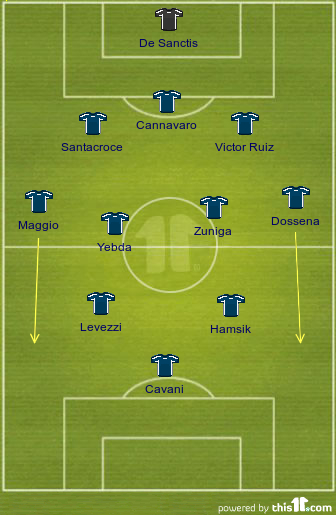
Evidence can also be found in Spain’s La Liga. Villarreal have lined up 4-2-2-2 for the majority of the previous season under Juan Carlos Garrido, a formation that contains two holding midfielders, two central attacking midfielders and two strikers – an upside-down T-shape – whereas recently-crowned champions Barcelona’s fluid 4-1-2-3 contains one holder, two central attacking midfielders and then Lionel Messi in the false 9 role which involves him dropping into the central attacking midfield area, giving his side, in effect, four central midfielders.

SPL examples
The first example, and perhaps the inspiration for this article, was the formations Celtic manager Neil Lennon deployed during the 2-2 draw at Ibrox in February. Celtic began the match in a lopsided 4-5-1 with Kris Commons wide left and Scott Brown in his, now familiar, tucked-in right sided role. The formation, therefore, contained four central midfielders, with one natural winger further forward.

Rangers dominated the early stages and opened the scoring early on, forcing Lennon to switch things around. He subsequently moved Commons into a central position just off Gary Hooper in attack, giving Celtic, in effect, five central midfielders. The four deeper-lying midfielders – now fluid and interchanging – all held central positions and now relied on the full-backs to provide width. The switch saw Celtic dominate the midfield area.

Similar examples of the above include Rangers’ 5-4-1, which also contained a narrow midfield four, first seen in the 2-2 draw away to Sporting Lisbon in the Europa League - the key difference being that Rangers’ midfield tended to be more rigid. As well as this, Derek McInnes has been known to line up St. Johnstone with a fluid central midfield four, usually in the form of three out-and-out central midfielders and Liam Craig in a tucked-in left-sided role.
Colin Calderwood has favoured a 4-1-3-2 formation for the most part since taking over as Hibernian manager towards the end of last year. The 4-1-3-2 involves Victor Palsson sitting just ahead of the defence as a deep-lying playmaker and is usually accompanied by three central midfielders just ahead of him, although there have been one or two occasions where one of the three is naturally a winger and thus has a tendency to drift wide.


In all of the above examples, the sides rely on their full-backs or wing-backs to advance and provide width. One example that does not necessarily involve pushing the full-backs on can be found with St. Mirren. Danny Lennon set his side up in a 4-3-2-1, or Christmas tree formation, during a recent trip to Ibrox which contained two attacking midfielders – Paul McGowan and Aaron Mooy- just ahead of three more industrious central midfielders – Paddy Cregg, Jim Goodwin and Steven Thomson – giving them five players in central midfield positions. The tactic worked for the most part as St. Mirren reduced the home side to few clear-cut chances and in the end narrowly lost the match to a second half Steven Whittaker penalty.
Drifting wingers
Evidence of sides packing the midfield area can also be found with a few clubs who tend to field players as a drifting winger or winger-cum-second-striker, that is, a player who starts in a wide position but who has a tendency, sometimes a compulsion, to drift into central areas. Perhaps the player in the SPL to play this role to the greatest effect is Steven Naismith of Rangers, although he usually executes this as part of a 4-4-2, giving Rangers a third central midfielder.
We would have to look to Scotland’s recent victory over Wales to find an example of three central midfielders being given extra help in that area by Naismith as a drifting winger. It is notable that Naismith, and Scotland as a whole, were not nearly as effective when Naismith was deployed as a second striker behind Kenny Miller in the following match against the Republic of Ireland.
Where the drifting wingers have caused sides to have, in effect, more than three central midfield players can be found in the following examples. Even though we have already discussed Celtic above, the formation mentioned was pretty much a one off as Lennon seemed to favour a two-striker formation most of the time. This did not detract from his desire to pack the midfield, however. For the second half of the season, Lennon’s most used formation was a lopsided 4-4-2. The starting positions included two holders – for example, Joe Ledley and Beram Kayal – with Scott Brown again in a tucked-in, right-sided role and Kris Commons on the left wing and more advanced. Commons, however, would often drift inside to central areas to collect the ball and link play between the Celtic midfield and attack. The movement of Commons meant that at many points during matches, Celtic had four players in central midfield positions.

At one point later in the season it appeared that Celtic were moving towards more of a 4-2-2-2, bearing some similarities to that of Villarreal mentioned earlier, with Brown slightly more advanced than usual and Commons pretty much as a central attacking midfielder. However, this formation didn’t last long and Lennon soon reverted back to the lopsided 4-4-2

Once Danny Swanson and Craig Conway returned from injury, Peter Houston was able to revert his Dundee United side back to his favoured 4-5-1-cum-4-3-3 formation with a V-shaped midfield. In this set up, Swanson is pretty much given free reign to drift all over the park. He will occasionally pop up on the opposite wing but spends a lot of time coming inside to occupy the area behind David Goodwillie and sometimes even drops as deep as the centre circle to collect the ball and start off attacks. It is also worth noting that Houston has also been willing to switch to a Christmas tree formation during matches, in effect, giving his side five central midfielders.
David Obua did something similar in Hearts’ 4-0 defeat to Rangers last month, albeit from a deeper starting position. It seems from the above that even though the starting positions of most sides suggests X amount of midfielders, a growing number of managers are instructing one of their wide players to either play a tucked in role, in other words a halfway house between wide and a central midfielder, or else as a drifting winger in order to give their side more bodies in the centre of the pitch while retaining some sort of width from midfield.
Reasons
One reason for the loading of central midfield areas has already been alluded to. This area of the pitch is often of paramount importance as winning the midfield battle is frequently the difference between victory and defeat. Having an extra man in the centre of midfield gives a side more chance of dominating possession and this is one of the reasons why 4-4-2, in its traditional form, has largely disappeared. The move away from 4-4-2 to two band formations has ultimately been aided by the liberalisation of the offside law which creates more space in central midfield areas and this, naturally, leads to more players being positioned where there is more space.
Furthermore, squeezing more players into central midfield positions has a positive effect on both the defensive and attacking capabilities of the side. Not only do the two or three holding midfielders offer their defence more protection, meaning that it is easier to win the ball, but when the ball is eventually won there are more passing options around the player in possession.
One further reason, related to the point in the previous paragraph, regards the apparent rise of strikerless formations in recent years. Craig Levein was, perhaps justifiably, lambasted for experimenting with a 4-6-0 in a Euro 2012 qualifier last year although a number of top teams have effectively employed such a tactic, most notably Barcelona, Manchester United and Roma. One of the thoughts behind this, which is related to our more general point that sides are deploying more central midfielders, is that once the ball is won it is more effective – or from the perspective of the opposition, more difficult – to have midfielders running at and beyond defenders rather than having strikers pushed high up the pitch with their back to goal.
So even though there seems to be little or no examples of a side in the SPL that doesn’t line up in four bands, it seems now that there are many examples of the two midfield bands becoming increasingly populated, be it from fielding more actual central midfielders or else by deploying wingers or wide midfielders who drift inside. Overall it seems that packing the midfield, more specifically the centre of midfield, is on the rise although not in the traditional sense and not necessarily with the aim of moving towards more negative football.
Thursday, 19 May 2011
Celtic v Motherwell - Scottish Cup Final Preview
Celtic will be without Joe Ledley and Beram Kayal but Kris Commons returns from suspension and will almost certainly start after netting nine times in his previous nine appearances. Motherwell have a full squad to choose from, meaning the only selection worries Stuart McCall has is who to leave out of his starting eleven.
Celtic
With the absence of Ledley and Kayal in the last few games, Neil Lennon has moved Scott Brown into the centre of midfield alongside Ki Sung-Yeung. In order to add more industry to the midfield, Charlie Mulgrew has been moved from his makeshift central defensive position to a makeshift midfield role. Mulgrew has been deployed on the left-side of midfield but in a more tucked in role, like that of Brown for much of the season only on the opposite side. The knock-on effect has been to move Kris Commons over to the right, meaning that we are now seeing a mirror of the lopsided 4-4-2 that Lennon has preferred for much of the season.
With Mulgrew being moved into midfield, Glenn Loovens has found himself restored to the starting line-up recently. The Dutchman will take his place in an otherwise familiar back four. The only other decision for Lennon is who to select in attack. Gary Hooper is a certain starter but he then has to choose between Anthony Stokes and Georgios Samaras to partner him.
Samaras broke his duct of only being selected for Old Firm matches when he was selected to play against Motherwell at the weekend and managed to get on the scoresheet. Hooper and Stokes have a great understanding and their link up has been excellent at times this season, although Stokes seems to have been overlooked when the bigger matches arise, including Celtic’s previous cup final appearance this season.
Motherwell
With the cup final in mind, Stuart McCall has chopped and changed, rested and experimented in recent weeks so his last few line-ups and formations will have no bearing on his selection for Saturday.
The Motherwell manager has a full squad to choose from and has let it be known this week that he has decided upon his starting eleven with the exception of one position. This could possibly be related to what formation he is deciding to go with. When he first took charge, McCall experimented with a number of formations but settled upon a 4-4-2 (which became a 4-2-3-1 in possession) when Motherwell hit their best run of form since he took charge.
Despite this, Motherwell’s 2-0 victory over Celtic in February saw McCall line up his side in a 4-5-1 formation, matching Celtic man-for-man in the middle of the park. The formation also included two pacey wingers that were positioned high up the pitch, pressing against Celtic’s full-back, thus, nullifying the threat they posed.
For that reason, as well as the probability that McCall will want to keep it tight early on, I think that Francis Jeffers, who usually partners John Sutton in attack, will have to make do with a place on the bench to make way for an extra central midfielder. This means that the main selection worry that McCall was alluding to was more likely whether to go with Steve Jones or Chris Humphrey on the right wing but more on this below.

Key Battles
Whether or not Motherwell start the match with a central midfield two or a central midfield three, this area will be one of the key areas of the field. Celtic’s formation is such that they, in effect, have three central midfielders, meaning that Motherwell will find themselves overrun should they go with 4-4-2. So assuming Motherwell start 4-5-1 then Hateley-Jennings-Lasley up against Brown-Ki-Mulgrew will be an intriguing contest.
Even if matched man-for-man in the centre of midfield, Celtic’s ace in the hole could be Kris Commons. The Scotland international’s starting position is that of a winger although he likes to drift inside and occupy the space between the lines, no matter which side he starts on. With the central midfield three of each side lining up man-form-man against each other, Commons may just be the man to find space and punish Motherwell.
The above means that Celtic’s midfield tends to be narrow but, as has been a feature of their play and a successful tactic for much of the season, they like to get their full-backs forward to provide width. Mark Wilson and Emilio Izaguirre have both been dangerous when getting forward though, as mentioned earlier, the presence of two Motherwell wingers high up the pitch may cause them to think twice before their forays into the opposition half, therefore, making them less of a threat.
Which takes us back to McCall’s main selection problem: Jones or Humphrey? Jones is tricky and has more of an end product, whereas Humphrey is, for the most part, pure pace. Jones likes to cut inside when on the right wing, whereas for Humphrey it’s all about hugging the touchline, getting outside the full-back and hitting the byline.
All things considered, Humphrey may just be the better choice. Izaguirre has shown a little bit of fragility to the defensive side of his game – most notably in the post-split fixtures versus Inverness and Motherwell – and Humphrey may not only cause the Honduran to stay back more often, he may possess the attributes to punish him more effectively. The other option is to keep Humphrey for later on in the match and use him as an impact substitution when everyone else is tiring as the pace he possesses could be deadly at that point. The trouble with this is that it gambles that the match will still be alive come the latter stages.
Whichever player McCall decides upon, it will be interesting to see whether he, along with Jamie Murphy on the other wing, can not only prevent the Celtic full-backs from moving up the pitch and get involved in attacks, but also punish them if they do decide to get forward.
Friday, 13 May 2011
Our game shamed again
Labour MSP Trish Godman rightfully described last night's events inside Tynecastle, in which a supporter attempted to attack Neil Lennon, as "disgusting". However, her comment that "security at Hearts should be looked in to" are slightly wide of the mark.
It is possible that a similar incident can or could have happened at any football ground in the country. In fact, three and a half years ago, a similar incident did take place at Celtic Park during a Champions League match when a supporter entered the field of play to taunt (I am loathe to use the word 'attack') AC Milan goalkeeper Dida.
Stepping up the security around the dugouts, or at least around the dugouts that Neil Lennon frequents, would be a smart move but other than that there does not seem to be any foolproof way of preventing people entering the field of play and surrounding areas during a football match. More bodies, sheer numbers would be a costly solution and would only minimise, not eradicate, the potential of something similar happening in the future.
Many newspapers and rolling news channels have gone with this as their top story this morning. Not only has this idiot that attempted to attack Lennon cost his club financially - money that would have been invested in youth or else used to service debt - he has tarnished the image of the club and, as Hearts fans know, this has been a problem their club has faced for a number of years now.
I was ashamed to wake up a Hearts supporter this morning.
Lennon's comments about other teams' lack of effort against Rangers recently and his touchline manner no doubt exacerbated an already volatile Tynecastle atmosphere, but this is no excuse in any way, shape or form for behaviour such as this to occur.
This is the second such incident to happen at Tynecastle in two years. Derek Riordan was subject to a similar attempted attack by a Hearts supporter immediately after scoring a penalty to put his side 1-0 up in an Edinburgh derby towards the end of the 2008/09 season. I just hope for the sake of the image of Hearts, and for that of Scottish football, that this is the last and we can get back to talking about the football, after a season of focusing on anything but.
As well as the governing bodies' inability to take the sport in the country forward, the media focus has been on such incidents as continued sectarian singing, bombs in the post and death threats, as well as fans' outrage when a manager goes on to the pitch to congratulate his team and supporters in a non-threatening manner.
Let's get back to talking about the football.
It is possible that a similar incident can or could have happened at any football ground in the country. In fact, three and a half years ago, a similar incident did take place at Celtic Park during a Champions League match when a supporter entered the field of play to taunt (I am loathe to use the word 'attack') AC Milan goalkeeper Dida.
Stepping up the security around the dugouts, or at least around the dugouts that Neil Lennon frequents, would be a smart move but other than that there does not seem to be any foolproof way of preventing people entering the field of play and surrounding areas during a football match. More bodies, sheer numbers would be a costly solution and would only minimise, not eradicate, the potential of something similar happening in the future.
Many newspapers and rolling news channels have gone with this as their top story this morning. Not only has this idiot that attempted to attack Lennon cost his club financially - money that would have been invested in youth or else used to service debt - he has tarnished the image of the club and, as Hearts fans know, this has been a problem their club has faced for a number of years now.
I was ashamed to wake up a Hearts supporter this morning.
Lennon's comments about other teams' lack of effort against Rangers recently and his touchline manner no doubt exacerbated an already volatile Tynecastle atmosphere, but this is no excuse in any way, shape or form for behaviour such as this to occur.
This is the second such incident to happen at Tynecastle in two years. Derek Riordan was subject to a similar attempted attack by a Hearts supporter immediately after scoring a penalty to put his side 1-0 up in an Edinburgh derby towards the end of the 2008/09 season. I just hope for the sake of the image of Hearts, and for that of Scottish football, that this is the last and we can get back to talking about the football, after a season of focusing on anything but.
As well as the governing bodies' inability to take the sport in the country forward, the media focus has been on such incidents as continued sectarian singing, bombs in the post and death threats, as well as fans' outrage when a manager goes on to the pitch to congratulate his team and supporters in a non-threatening manner.
Let's get back to talking about the football.
Tuesday, 3 May 2011
Tactical shorts: Celtic 4 Dundee United 1

Celtic responded to Rangers' emphatic win the previous day with a comfortable win of their own.
With Joe Ledley missing, Neil Lennon opted to move Scott Brown into a central role and go with two wingers. Kris Commons played his usual role of switching between wide and central positions with James Forrest more of an out-and-out winger. Commons began on the left but was moved to the right, with Forrest switching to the left, after less than ten minutes. The pair switched once again at the start of the second half. Antony Stokes was restored to the starting line up and was the more advanced of the front two with Gary Hooper in a deeper role than he is known for.
Dundee United were at full strength and began in their usual 4-5-1/4-3-3 formation with a fluid midfield five. They pushed their full-backs on and attempted to attack from the off, rather than soaking up pressure like most teams that visit Celtic Park do.
The match began with both sides displaying equal amounts of stray passes and quick, intricate periods of possession. After the first goal, which involved a shocking error from Garry Kenneth and some excellent link up play from Stokes and Hooper, Dundee United became impotent as an attacking threat and only began to threaten again when they conceded a second and introduced Johnny Russell from the bench.
Midfield battle
Celtic were outnumbered by three to two in the centre of the pitch but a few different reasons negated this. Firstly, Scott Brown and Beram Kayal put it excellent performances, especially in a defensive sense. The tenacity of the pair and their constant harrying meant that Dundee United struggled to work the ball through the centre of the pitch.
Secondly, Celtic’s strategy was to move the ball quickly to Forrest and Commons and push the full-backs on. With their height disadvantage in attack, they then focused on working the ball across the goal in the form of cut backs and low, driven crosses.
One final reason was that the positions of Commons and Hooper meant that, at times, Celtic did have a third man in the centre of the pitch.
Celtic’s full-backs
Relatedly, Mark Wilson and Emilio Izaguirre were back to their attacking best. In recent matches, Wilson has, through design or necessity, found himself staying back more often than not, while some sides have managed to lessen the threat of Izaguirre. On Sunday, however, both managed to get forward on a number of occasions, provide support to the attack and put in dangerous crosses.
This had the knock on effect of causing the Dundee United wingers, Danny Swanson and Craig Conway, to track back more often than they would have liked, leaving Daniel Majstorovic and Charlie Mulgrew to deal with the isolated David Goodwillie.
Substitutions
Both managers made substitutions that made an impact on the game. After going 2-0 down, Peter Houston replaced Prince Bauben and Danny Swanson with Jon Daly and Johnny Russell and moved to a 4-4-2.
Dundee United instantly improved which was evidenced when Russell cut inside from the right wing and struck the post with a left foot strike. Russell wasted another chance when he decided to go for goal rather than squaring it to Goodwillie for a tap-in. Russell eventually scored in injury time but by that time it was too late and his side were three goals behind.
Lennon responded to the Dundee United substitutions by introducing Ki Sung-Yeung for Forrest and moving Brown to his, now familiar, tucked-in right sided role in a lopsided 4-4-2. It was now Celtic who had the man advantage in the centre of the park and the presence of Ki meant that they were able to utilise possession better and slow the pace of the game down.
A further substitution on seventy-five minutes saw Shaun Maloney replace Hooper and take up a trequartista role. Again this helped Celtic retain possession with the added bonus of a third goal which Maloney provided the assist for.
One final substitution for Celtic saw Brown withdrawn to be replaced by Daryl Murphy. Murphy restored Celtic’s three goal advantage with a fine solo effort in the final minute of injury time.
Subscribe to:
Posts (Atom)