With the events of the last week, within which Ally McCoist was placed on gardening leave, it is Kenny McDowall who is now tasked with guiding this Rangers side through the remainder of a turbulent season.
If the Rangers supporters thought that an uninspiring appointment, albeit temporary, they would be just as underwhelmed when they saw the caretaker boss’s first team selection. McDowall was given the opportunity to put his own stamp on the current side. He could have changed the shape and introduced some players that found appearances difficult to come by under McCoist. Instead he picked exactly the same personnel in exactly the same archaic formation as has become the norm at Rangers this season.
Nicky Clark partnered Kenny Miller in the attack of a 4-4-2, which saw the centre of their midfield drowned by the 4-3-1-2 of Hibernian. With Dominique Malonga and Jason Cummings taking turns to drop deep, this meant even more of a mismatch in the centre of midfield and the problem was highlighted early in the match when both Nicky Law and Ian Black were caught out up the pitch as Hibs countered.
The shape of the Hibernian midfield and the advanced nature of their full-backs meant that they contained sufficient width when attacking – evidenced by the performances of David Gray and Lewis Stevenson – and enough cover when defending.
Much of the positivity on the progression of Stubbs’s side has been focused on the performances of Scott Allan and today was no different. Due to Hibs' numerical advantage, he was free to dictate play for most of the match and was involved in all four goals. For the opener, Allan burst forward off the ball and dragged Stevie Smith into the centre to pick him up. This created space for David Gray to collect the ball and fire Hibs ahead after 8 minutes.
For the second goal, Smith was in position when Allan collected the ball but failed to get close enough to stop the cross. Allan’s ball found Craig, who volleyed back for Cummings to tap into an open goal. Allan then capped off a majestic performance with two clever assists in the second half to give Hibernian a 4-0 victory.
It should not be surprising to see Hibs dominate this match as Alan Stubbs has won the tactical battle in many of the big matches this season. He was dominating McCoist – changing his formation at the correct time – before Danny Handling was sent off in the Petrofac Training Cup at the start of the season and, much like this match, he blitzed Rangers in the first half of the previous league meeting between the sides.
Furthermore, he more than matched Hearts for large parts of the opening Edinburgh Derby of the season and, but for an injury-time wonder strike, was seconds away from victory in the second at Easter Road.
Rangers, by contrast, have been found wanting in most of the big matches in the Championship this season. Even in the matches they have edged the initial tactical battle – the recent performance at Tynecastle, for instance – they have still gone on to lose the match. In four Championship matches versus Hearts and Hibs this season, Rangers have lost all four.
And there is nothing in the pre- or post-match interviews of McDowall, nor from the performance of the team, to suggest that he is the man to inject some modernity into the Rangers tactics. It is rather telling by his comments after the match, in which he revealed that he is being “told to carry on”, that he is either unwilling or unable to take charge of this Rangers side.
McCoist liked his team to knock the ball into the channels and work it down the wings, always looking for the overlap from the full-backs and that is exactly what we got from McDowall in this match. If further confirmation was needed that working the ball wide and crossing the ball as often as possible hasn't worked, you only have to look at the full-time statistics: Rangers had 7 attempts with 1 on target - Hibernian had the same amount of efforts but hit the target 5 times - and had 8 corners to Hibernian’s 0.
One of the reasons most of the Rangers play was focused down the wings was to avoid the congested central areas in which they were outnumbered. It appeared that McDowall had identified this when Kyle Hutton was stripped and ready to come on after 34 minutes. Unfortunately for Rangers, he hadn't and Hutton was nothing more than a like-for-like replacement for Ian Black before the former Hearts man collected a second yellow card. The change may have improved the Rangers performance for a short period, but the same issues remained.
Even the half-time substitution made little sense. Kris Boyd was introduced for Fraser Aird but instead of changing the shape of the side, Clark was moved to the right of midfield in the same formation that Rangers have played for about 37 years now.
It is perplexing that a qualified football coach, despite his lack of experience as a football manager, failed to notice or rectify the major tactical issue his side faced in the match. Rangers had two strikers on the pitch for the whole of the match, yet their manager failed to notice that having two strikers is useless if you cannot win the ball when out of possession or else supply them when in possession.
Showing posts with label Hibernian. Show all posts
Showing posts with label Hibernian. Show all posts
Saturday, 27 December 2014


Monday, 18 August 2014
What They Said: Stubbs, Hartley & Adams
The post-match interview is the avenue through which managers address the supporters and wider public in the wake of, say, a dominant performance or a total capitulation. Some, like well-trained politicians, choose to deflect questions as if they weren't asked while some can't seem to move beyond tired clichés. There are those who honestly address the issues at hand, then there are those who refuse to face certain media outlets at all. 'What They Said' picks apart selected post-match interviews from the weekend in Scottish football.
Alan Stubbs
The Hibernian manager has now lost two from two against opposition they are widely expected to challenge for the Championship title this season - even though the Rangers match came in the Petrofac Training Cup. Both matches have been lost 2-1 and Hibernian have failed to lead at any point in either game, despite being awarded a penalty with the score at 0-0 in Sunday’s Edinburgh derby. Regardless, manager Alan Stubbs didn't “think the [final] scoreline [versus Hearts] reflected the game.”
To give him his due, the former Celtic defender appears to be instilling a more progressive style at Easter Road and has made some decent signings so far, most notably a proven Championship striker (who has netted twice already) as well as the first decent right-back at the club for around seven years. It is also true that his side have shown some “really encouraging signs” and have “come a long way in a short space of time.”
Stubbs had the better of Robbie Neilson in the opening exchanges on Sunday, pressing the home side so that they couldn't distribute to the defence, forcing a nervous-looking Jack Hamilton to kick poorly. He also had the better of Ally McCoist for large parts of their cup tie. In that match, Stubbs’s side dominated midfield due to McCoist believing that it would take three central defenders to nullify the threat of Farid El Alagui. Then, when McCoist switched to a back four, Stubbs made the correct decision to go with two strikers up against two centre-backs. Unfortunately, Danny Handling’s red card minutes later meant we never saw how Rangers would have coped, or how their manager would have responded.
However, even if they continue to perform yet find themselves unable to challenge, how long will these types of rationalisations wash with the Hibernian faithful? They are, by now, well-accustomed to managers claiming that their side played well despite the defeat, although this previously came from the mouths of more regressive managers in Pat Fenlon and, more recently, Terry Butcher. Even though Stubbs already seems to have more tactical nous than either of the two previous managers, the deficiencies in his squad are still there to be seen.
None more so than the mentality of some of his players, especially in the centre of midfield. During Sunday's derby, after a decent start to the match, captain Liam Craig lost his composure to miss a first-half penalty and never seemed to recover. He was even found projecting his own failings and indiscipline on to the Hearts players towards the end of a bad-tempered match.
And what about his midfield partner? Scott Robertson got booked for throwing himself into anyone he could find and was nutmegged for the opening goal. He then, like Craig, failed to regain his self-control and conceded a penalty which effectively lost his side the game and, further, brought about his dismissal. Perhaps this is what Stubbs was referring to when he spoke of “ill discipline” costing the team.
These are the players tasked with protecting a vulnerable defence, igniting attacks and being two of the more experienced heads to guide the younger players through matches. It appears, on Sunday’s evidence, that while they may have some attacking capabilities – more so in the case of Craig – they lack the required discipline and temperament to protect their back four and to leader others.
Paul Hartley
Dundee fought their way to a third successive league draw on Saturday versus Partick Thistle and have 17-year-old Craig Wighton to thank after scoring following his half-time introduction. The teenager won a new contract prior to his first top-flight goal and afterwards received some lavish praise from his manager.
The praise came seconds after manager Paul Hartley dared not to over-hype the youngster. “We don’t want to say too much because we know how good he is”, but the former Scotland international seemed to forget his own words instantly as he went on to describe Wighton as “…the future of our club.”
Dundee’s managing director John Nelms, as well as defender James McPake, have since further played-down the young striker's abilities, respectively describing Wighton as “an exceptional young talent with maturity beyond his years” and “…up there with the best”.
I wonder what they would have said had they over-hyped him.
Derek Adams
Finally, fresh after stating it did not matter how his side played in their 4-0 defeat to Partick Thistle on Wednesday, Derek Adams displayed perfectly the rampant hypocrisy found in just about any post-match interview. For the two goals conceded in a 2-1 home defeat to Kilmarnock at the weekend, Ross County have “…got to stop the cross…and the ball getting to the attackers for headers”, according to Adams. Yet for County’s own headed-goal - which came with just ten minutes remaining - was not only a “…good goal from Liam Boyce. It’s a good cross from Joe Cardle”.
Alan Stubbs
The Hibernian manager has now lost two from two against opposition they are widely expected to challenge for the Championship title this season - even though the Rangers match came in the Petrofac Training Cup. Both matches have been lost 2-1 and Hibernian have failed to lead at any point in either game, despite being awarded a penalty with the score at 0-0 in Sunday’s Edinburgh derby. Regardless, manager Alan Stubbs didn't “think the [final] scoreline [versus Hearts] reflected the game.”
To give him his due, the former Celtic defender appears to be instilling a more progressive style at Easter Road and has made some decent signings so far, most notably a proven Championship striker (who has netted twice already) as well as the first decent right-back at the club for around seven years. It is also true that his side have shown some “really encouraging signs” and have “come a long way in a short space of time.”
Stubbs had the better of Robbie Neilson in the opening exchanges on Sunday, pressing the home side so that they couldn't distribute to the defence, forcing a nervous-looking Jack Hamilton to kick poorly. He also had the better of Ally McCoist for large parts of their cup tie. In that match, Stubbs’s side dominated midfield due to McCoist believing that it would take three central defenders to nullify the threat of Farid El Alagui. Then, when McCoist switched to a back four, Stubbs made the correct decision to go with two strikers up against two centre-backs. Unfortunately, Danny Handling’s red card minutes later meant we never saw how Rangers would have coped, or how their manager would have responded.
However, even if they continue to perform yet find themselves unable to challenge, how long will these types of rationalisations wash with the Hibernian faithful? They are, by now, well-accustomed to managers claiming that their side played well despite the defeat, although this previously came from the mouths of more regressive managers in Pat Fenlon and, more recently, Terry Butcher. Even though Stubbs already seems to have more tactical nous than either of the two previous managers, the deficiencies in his squad are still there to be seen.
None more so than the mentality of some of his players, especially in the centre of midfield. During Sunday's derby, after a decent start to the match, captain Liam Craig lost his composure to miss a first-half penalty and never seemed to recover. He was even found projecting his own failings and indiscipline on to the Hearts players towards the end of a bad-tempered match.
And what about his midfield partner? Scott Robertson got booked for throwing himself into anyone he could find and was nutmegged for the opening goal. He then, like Craig, failed to regain his self-control and conceded a penalty which effectively lost his side the game and, further, brought about his dismissal. Perhaps this is what Stubbs was referring to when he spoke of “ill discipline” costing the team.
These are the players tasked with protecting a vulnerable defence, igniting attacks and being two of the more experienced heads to guide the younger players through matches. It appears, on Sunday’s evidence, that while they may have some attacking capabilities – more so in the case of Craig – they lack the required discipline and temperament to protect their back four and to leader others.
Paul Hartley
Dundee fought their way to a third successive league draw on Saturday versus Partick Thistle and have 17-year-old Craig Wighton to thank after scoring following his half-time introduction. The teenager won a new contract prior to his first top-flight goal and afterwards received some lavish praise from his manager.
The praise came seconds after manager Paul Hartley dared not to over-hype the youngster. “We don’t want to say too much because we know how good he is”, but the former Scotland international seemed to forget his own words instantly as he went on to describe Wighton as “…the future of our club.”
Dundee’s managing director John Nelms, as well as defender James McPake, have since further played-down the young striker's abilities, respectively describing Wighton as “an exceptional young talent with maturity beyond his years” and “…up there with the best”.
I wonder what they would have said had they over-hyped him.
Derek Adams
Finally, fresh after stating it did not matter how his side played in their 4-0 defeat to Partick Thistle on Wednesday, Derek Adams displayed perfectly the rampant hypocrisy found in just about any post-match interview. For the two goals conceded in a 2-1 home defeat to Kilmarnock at the weekend, Ross County have “…got to stop the cross…and the ball getting to the attackers for headers”, according to Adams. Yet for County’s own headed-goal - which came with just ten minutes remaining - was not only a “…good goal from Liam Boyce. It’s a good cross from Joe Cardle”.
Thursday, 8 August 2013
Edinburgh Derby Preview
With the removal of the Glasgow derby from what turned out to be the
final SPL season, a lot of the television marketing weight was put behind its
Edinburgh equivalent to compensate. Instead of emerging as the most anticipated
fixture, it bored its audience to the point where its future presence on
television was dreaded. Far greater entertainment was provided from the
enterprising football of Stuart McCall’s Motherwell, the unyielding St.
Johnstone and the rise of the Highland clubs.

The final Edinburgh derby of the 2012/13 season produced three goals -
fabulous strikes from Leigh Griffiths and especially from Ross Caldwell
cancelled out Darren Barr’s earlier whatever-that-was – but
the previous two had ended goalless and followed a middling encounter from
early in the season. Overall the fixture contributed only five goals across
four SPL meetings and not enough quality to justify the hype. I will be finding
it difficult not to cringe during the live TV coverage when the inevitable
cheesy promotional reel that precedes the punditry hopelessly attempts to build
the match up this time around.
Hearts scored only 40 goals last season, with 10 of them coming in the
final six matches. In football parlance, that would usually indicate some
goal-scoring form worth mentioning, however, the Hearts squad has since
regressed and is currently strikerless. Ryan Stevenson and Callum Paterson are
the two tasked with filling the void, but Hearts supporters have seen enough of
both in that position – even if, admittedly, less so of Paterson - to not be too optimistic about these options.
That’s not to say that neither will find the net, just that it is
doubtful whether either can be prolific enough to satisfy Hearts’ needs. A friend of mine swore that one of them had
possession in the St. Johnstone penalty area last weekend but it didn’t make
the Sportscene highlights, so it’s
unconfirmed on my part. Almost every outfield player in Hearts’ diminutive
first-team squad is required to produce at least a goal or two if they are to overcome
their fifteen point deficit and get anywhere close to the league’s other sides.
But since the fixture list was released, Gary Locke will have had an
eye on Sunday’s match knowing it would be an ideal opportunity to fire-up his
players, sneak a result and embark on the run that will ultimately give them a
chance of survival. And the earlier the better because if the Tynecastle club fail
to and if a season such as the preceding one unfolds – Dundee aside, but there
are reasons for their poor showing – every other club will be too far away by
the time they reach zero.
Things aren’t looking much better, form wise, down at Easter Road though
they will also see Sunday as a potential catalyst for a decent run of form.
Hibernian will be looking to put their early season mauling at the hands of Malmö and their uninspiring season opener at home
to Motherwell behind them. A derby victory to rub salt into the wounds of a
bleeding Hearts would certainly aid that.
Goals have been an issue for
Pat Fenlon’s side as well - three games, no goals so far this season - but this
weekend will be the first time he has both Rowan Vine and James Collins to
choose from. Vine proved dangerous cutting in from the left side for St.
Johnstone last season and Collins already displayed some potential during his
debut. What’s more, the away side go into this match as favourites both in terms
of recent form in this fixture and when assessing the respective starting staring
elevens.
Pressure can often work against you though, even more so when fierce
rivalry is involved. A converted
Derek Riordan penalty earned a makeshift Hibs side, containing Steven
Thicot and an expiring Ian Murray at central defence, a 1-0 victory against an
in-form Hearts side at Tynecastle in 2009 and the current team will be hoping
that a similar upset, albeit in their disfavour, doesn’t occur.
If the unthinkable happened and Hearts were to snatch an unlikely
victory then time may be called on Pat Fenlon’s career at East Road. His win
percentage is dangerously close the other Hibs managers that have been forced
out the exit in recent years and this added to the poor showings at two
Scottish Cup finals, not to mention a record defeat in Europe for a Scottish
club, would be deemed inexcusable by many if it culminated in defeat at
Tynecastle.
For many but not for all, however, as these days the
Hibernian support is split into two opposing camps during their bleakest
periods: those who blame the manager and those who blame the chairman for
appointing the wrong man and/or not backing his choice sufficiently. Fenlon could
perhaps point to not being afforded adequate time thus far but cannot complain
about a lack of finances, as in a period of severe austerity for Scottish
football Hibernian have spent somewhere in the region of £200,000 on Collins as
well as a nominal fee on Bradford defender Michael Nelson.
Other proponents of sticking by the manager would point to the
proverbial gelling of the squad being in its rudimentary stages and that
changing manager directly following pre-season is counterproductive. The
performances of the new recruits at their previous clubs suggest that given time they will
strengthen the squad and assist the club in beginning to climb the league.
Giving Fenlon until later in the year would allow his new signings to settle
and begin hitting the form that attracted their attention in the first place.
The smart money for this match is that neither seizes the moment and
that a dour, low-scoring draw that does nothing to help either side awaits.
Failing that a narrow victory for either side is expected, with Hibernian the
most likely. It is possible, however, that the negative angle of this piece was
misguided from the start. It’s a new season with all new, yet chored, branding
and with yet another new dynamic surrounding this Edinburgh derby. It may just
surprise us all and throw up a spectacle that we had previously come to expect
from this fixture when it lurked in the shadows of the Glasgow derby.
Saturday, 17 September 2011
Dunfermline 2 Hibernian 2
Dunfermline continued their poor defensive record at home this season but managed to come from two goals behind to salvage a point. It was a case of poor defending, as opposed to devastating attacking play, which brought about the four goals in this match.

Dunfermline made one change to the side that lost 3-2 away to Kilmarnock last week, replacing the injured Craig Easton with youth academy product Ryan Thomson. For the first time this season, Jim McIntyre chose to go with 4-1-4-1 at home – his preferred formation away from home – abandoning his usual 4-4-2.
Colin Calderwood welcomed former-Hearts assistant Billy Brown to his dugout for the first time and stuck with the 4-4-2 used in recent weeks. Callum Booth returned at left-back in place of the injured Ian Murray and Leigh Griffiths was given his first start at the expense of Junior Agogo.
The only difference in terms of shape was to move Ivan Sproule over to the left and Martin Scott to the right. With only one natural winger, this gave the Hibernian midfield a lopsided shape similar to that used by Neil Lennon’s Celtic.
The initial strategies of the sides were in stark contrast to one another. Whereas the home side looked to build from the back and work the ball through midfield, where they had a man advantage, Hibernian looked to hit the forwards quickly with long balls.
With the pace of Griffiths and Sproule up against the slow back four of Dunfermline, a better strategy would surely have been to retain possession, tempt their opponents out and then exploit the space in behind. However, when Hibernian’s play did eventually settle and they attempted to play the ball from the back themselves, they looked short of options and would eventually revert back to long, direct passes.
Hibernian’s left-hand side
Readers of this blog will be aware that Hibernian have been particularly vulnerable down their left side this season and today was no different. The Dunfermline manager obviously identified this as a potential weakness but rather than double up on the off-form Booth, his strategy was to instruct Danny Graham to drift into central areas, both with and without the ball, luring Booth out of position and using Jason Thomson on the overlap.
Even though none of the Dunfermline goals came directly from this side, they created a number of chances from this area that should have led to goals. To mention just two, Jason Thomson hit the side netting midway through the first half when he should have cut the ball back for a tap-in and Graham should have taken a shot at goal rather than cut it back, when he found himself in-behind Booth.
Again, I do not wish to single out Booth, he wasn’t helped much by Sproule - who failed to track back on a few occasions - but it was another poor performance from the young left-back.
Graham drifting into the centre of the pitch was a key feature of Dunfermline’s attacking play, which overloaded the centre of the pitch to the home side’s advantage. He weaved in and out of the Hibernian midfield consistently which should have earned him the man-of-the-match award – strangely, it was awarded to Ryan Thomson, who played well but was nowhere near the best player on the pitch.
Hibernian took the lead late-on in an even first half – both sides had their spells of possession and dominance – when Sproule finished off a quick move after a Richie Towell throw-in. The goal was very well taken but was indicative of the poor defending Dunfermline have displayed this season.
Second half
Hibernian emerged from the break in a 4-3-3 formation with Scott now in central midfield, rather than tucked in on the right side, and Griffiths moving over to the right of an attacking trident.
The switch appeared to suit the away side as they now matched Dunfermline man-for-man in the centre of the pitch and, further, it led to Garry O’Connor and Griffiths combining for the first time in the match.
The pair linked up minutes after the restart to force Paul Gallacher into a smart save and they combined once more to give Hibernian a two-goal lead after fifty-one minutes. Griffiths flicked a long punt from Graham Stack on to O’Connor and the former-Birmingham striker was afforded too much space to turn and unleash a deflected strike towards goal.
Hibernian’s two-goal advantage lasted all of fourteen seconds, however, as Graham was again allowed to drift inside, collect the ball and drive towards goal. His through ball was collected by Ryan Thomson, after Paul Hanlon lamely allowed the ball to simply bounce off him, and he knocked the ball past the advancing Stack.
Calderwood’s substitutions
After a brief feeling of comfort, the match was now Hibernian’s to throw away.
This was not helped by Calderwood’s strange choice of substitutions on the hour mark. It was not so much the players that were withdrawn but the players that were introduced and the resultant switch back to a 4-4-2 that was their downfall. O’Connor, possibly due to a knock sustained when challenged by Gallacher, and Griffiths, who is short of match-fitness, were taken off and replaced by Agogo and Akpo Sodje.
From then on Hibernian, again, found themselves a man short in the centre of the pitch and, as well as this, were now impotent in attack. Alex Keddie and Andy Dowie dealt far more comfortably with the two stocky strikers than they had with Griffiths and O’Connor.
Thus, it was no surprise when Dunfermline equalised through a Paul Hanlon own goal. Joe Cardle cut in from the left and saw his shot saved by Stack, but the ball fell to Jason Thomson in the box and his cross/miscued shot was knocked into his own net by the hapless defender.
Dunfermline continued to pile on the pressure but were unable to find a winner.
Conclusion
Today was a case of previous trends continuing to occur, for both sides.
The left side of Hibernian continues to be an issue, as does their manager’s apparent lack of a coherent strategy. His move to a 4-3-3 at the beginning of the second half looked to have won the game for his side but the introduction of Sodje and Agogo and subsequent move back to a 4-4-2 contributed to their capitulation.
Dunfermline have now conceded nine goals in four home matches, which goes a long way to explaining why their only victories have come away from home. Nonetheless, McIntyre deserves some credit for the way his side have applied themselves at the other end of the pitch. Two goals today takes their total goals at home to seven and, furthermore, their industrious midfield allows Cardle and Graham to join in attacks. On this form the pair will cause problems for most SPL defences they face.
However, as McIntyre himself has pointed out, he cannot expect his forwards to score four goals every encounter in order to win matches.

Dunfermline made one change to the side that lost 3-2 away to Kilmarnock last week, replacing the injured Craig Easton with youth academy product Ryan Thomson. For the first time this season, Jim McIntyre chose to go with 4-1-4-1 at home – his preferred formation away from home – abandoning his usual 4-4-2.
Colin Calderwood welcomed former-Hearts assistant Billy Brown to his dugout for the first time and stuck with the 4-4-2 used in recent weeks. Callum Booth returned at left-back in place of the injured Ian Murray and Leigh Griffiths was given his first start at the expense of Junior Agogo.
The only difference in terms of shape was to move Ivan Sproule over to the left and Martin Scott to the right. With only one natural winger, this gave the Hibernian midfield a lopsided shape similar to that used by Neil Lennon’s Celtic.
The initial strategies of the sides were in stark contrast to one another. Whereas the home side looked to build from the back and work the ball through midfield, where they had a man advantage, Hibernian looked to hit the forwards quickly with long balls.
With the pace of Griffiths and Sproule up against the slow back four of Dunfermline, a better strategy would surely have been to retain possession, tempt their opponents out and then exploit the space in behind. However, when Hibernian’s play did eventually settle and they attempted to play the ball from the back themselves, they looked short of options and would eventually revert back to long, direct passes.
Hibernian’s left-hand side
Readers of this blog will be aware that Hibernian have been particularly vulnerable down their left side this season and today was no different. The Dunfermline manager obviously identified this as a potential weakness but rather than double up on the off-form Booth, his strategy was to instruct Danny Graham to drift into central areas, both with and without the ball, luring Booth out of position and using Jason Thomson on the overlap.
Even though none of the Dunfermline goals came directly from this side, they created a number of chances from this area that should have led to goals. To mention just two, Jason Thomson hit the side netting midway through the first half when he should have cut the ball back for a tap-in and Graham should have taken a shot at goal rather than cut it back, when he found himself in-behind Booth.
Again, I do not wish to single out Booth, he wasn’t helped much by Sproule - who failed to track back on a few occasions - but it was another poor performance from the young left-back.
Graham drifting into the centre of the pitch was a key feature of Dunfermline’s attacking play, which overloaded the centre of the pitch to the home side’s advantage. He weaved in and out of the Hibernian midfield consistently which should have earned him the man-of-the-match award – strangely, it was awarded to Ryan Thomson, who played well but was nowhere near the best player on the pitch.
Hibernian took the lead late-on in an even first half – both sides had their spells of possession and dominance – when Sproule finished off a quick move after a Richie Towell throw-in. The goal was very well taken but was indicative of the poor defending Dunfermline have displayed this season.
Second half
Hibernian emerged from the break in a 4-3-3 formation with Scott now in central midfield, rather than tucked in on the right side, and Griffiths moving over to the right of an attacking trident.
The switch appeared to suit the away side as they now matched Dunfermline man-for-man in the centre of the pitch and, further, it led to Garry O’Connor and Griffiths combining for the first time in the match.
The pair linked up minutes after the restart to force Paul Gallacher into a smart save and they combined once more to give Hibernian a two-goal lead after fifty-one minutes. Griffiths flicked a long punt from Graham Stack on to O’Connor and the former-Birmingham striker was afforded too much space to turn and unleash a deflected strike towards goal.
Hibernian’s two-goal advantage lasted all of fourteen seconds, however, as Graham was again allowed to drift inside, collect the ball and drive towards goal. His through ball was collected by Ryan Thomson, after Paul Hanlon lamely allowed the ball to simply bounce off him, and he knocked the ball past the advancing Stack.
Calderwood’s substitutions
After a brief feeling of comfort, the match was now Hibernian’s to throw away.
This was not helped by Calderwood’s strange choice of substitutions on the hour mark. It was not so much the players that were withdrawn but the players that were introduced and the resultant switch back to a 4-4-2 that was their downfall. O’Connor, possibly due to a knock sustained when challenged by Gallacher, and Griffiths, who is short of match-fitness, were taken off and replaced by Agogo and Akpo Sodje.
From then on Hibernian, again, found themselves a man short in the centre of the pitch and, as well as this, were now impotent in attack. Alex Keddie and Andy Dowie dealt far more comfortably with the two stocky strikers than they had with Griffiths and O’Connor.
Thus, it was no surprise when Dunfermline equalised through a Paul Hanlon own goal. Joe Cardle cut in from the left and saw his shot saved by Stack, but the ball fell to Jason Thomson in the box and his cross/miscued shot was knocked into his own net by the hapless defender.
Dunfermline continued to pile on the pressure but were unable to find a winner.
Conclusion
Today was a case of previous trends continuing to occur, for both sides.
The left side of Hibernian continues to be an issue, as does their manager’s apparent lack of a coherent strategy. His move to a 4-3-3 at the beginning of the second half looked to have won the game for his side but the introduction of Sodje and Agogo and subsequent move back to a 4-4-2 contributed to their capitulation.
Dunfermline have now conceded nine goals in four home matches, which goes a long way to explaining why their only victories have come away from home. Nonetheless, McIntyre deserves some credit for the way his side have applied themselves at the other end of the pitch. Two goals today takes their total goals at home to seven and, furthermore, their industrious midfield allows Cardle and Graham to join in attacks. On this form the pair will cause problems for most SPL defences they face.
However, as McIntyre himself has pointed out, he cannot expect his forwards to score four goals every encounter in order to win matches.
Monday, 29 August 2011
Hearts 2 Hibernian 0
Hearts deservedly defeated a toothless Hibernian side in the first Edinburgh derby of the season. Even though the football on display was not of the highest quality, it was an intriguing ninety minutes with plenty of commitment from both sets of players.

Paulo Sergio made eight changes from the 0-0 draw at White Hart Lane but only one change from their previous league outing. Ian Black returned from suspension and took his place in centre midfield alongside David Obua and Adrian Mrowiec. The inclusion of Obua suggested a 4-2-3-1 formation, however, the Ugandan international was deployed in a more reserved role in a tight central midfield three, meaning that the home side lined up 4-3-3.
Colin Calderwood made three changes from the league defeat to St. Mirren last week, dropping David Wotherspoon, Viktor Palsson and David Stephens in favour of Sean O’Hanlon, Junior Agogo and new loan signing Richie Towell. There was also a change in shape for the Easter Road side as Matt Thornhill was moved out to the left of midfield in a 4-4-2 formation.
The respective shapes meant that Hearts enjoyed an extra man in the centre of midfield. Further, their full-backs pushed on at every opportunity, forcing Thornhill and Ivan Sproule into defensive duties for most of the first half. The result was that Hearts edged possession.
Hearts focus down the left but get joy down the right
It is clear that the new manager is trying to instil a pass-from-the-back approach at Tynecastle, equally clear that some of the players aren’t suited to it and are finding it difficult to shake off their old habit of lumping the ball down the channels.
Club captain Marius Zaliukas, no stranger to the odd howler, was guilty of a few stray passes in the first half and Andy Webster, his central defensive partner, hit a few high, inaccurate passes in the direction of Andy Driver.
The exclusion of John Sutton, even from a place on the bench, is further evidence that Sergio is sceptical of fielding a target man as his lone striker and that he wishes his side to retain possession and create opportunities through passing moves, as opposed to feeding off knock-downs and second balls.
Conversely Hibernian took a direct approach, choosing to field two big strikers that they were all too happy to hit with long, direct passes. Agogo would look to drop off into space but his movement was tracked, more often than not, by Mrowiec.
The Hibs front two pressed the Hearts defenders, forcing them into the mistakes referred to above, although the rest of the side failed to follow suit. This meant that large gaps appeared between the Hibs front two and back eight, another reason why Hearts made better use of their possession.
Hearts attempted to play the ball to Driver at every opportunity and get him running at Towell. He rarely got the better of the Hibs right-back however, as Hearts struggled to create anything clear cut.
The teams had largely cancelled each other out – with Hibs missing the best chance of the half through Garry O’Connor – until around five minutes before half-time when a mistake allowed Hearts to take the lead.
Callum Booth tried to pick out Thornhill inside his own half. The pass wasn’t the greatest but the recipient was also at fault and allowed Jamie Hamill to disposes him before exchanging passes with Ian Black and cutting the ball back for Ryan Stevenson who finished from seven yards.
Further blame can be thrown the way of Isaiah Osbourne who made little attempt to track Stevenson’s run.
Second half
Hibernian emerged from the second half a different side. Calderwood moved Sproule to just behind the front two and Thornhill to the right in a midfield diamond formation. With the Hibernian full-backs pushing on for the first time in the match, they now enjoyed a man advantage in the midfield zone.
For the best part of ten minutes they had Hearts on the ropes, however, as soon as the home side created their first chance of the half, the momentum again swung their way. From then on there was only ever going to be one winner.
The advantage of enjoying an extra man in the centre of midfield, via a diamond formation, was outweighed by the formation’s major flaw. The narrow nature of the midfield means that the full-backs become exposed when defending. With the wide players Hearts possess, and the attacking nature of their full-backs, along with the poor form of Callum Booth so far this season, it was no surprise that Hearts created several opportunities down the Hibs left-hand side.
Three chances in quick succession were created down this side: Booth was nowhere to be seen when Stephen Elliott forced Graham Stack into a save; Stevenson then got in behind the same player to cut back for Elliott, who this time hit the post; and finally Hamill wasted an opportunity by electing to shoot when he should have cut the ball back for a tap in.
Calderwood responded by withdrawing Sproule and Agogo for Akpo Sodje and Leigh Griffiths on the hour mark, moving to a 4-3-3 formation. The difference between the 4-3-3 formation of Hearts and that of Hibernian was that Hearts’ wide players are more naturally wide players/midfielders who looked to track back. Hibernian’s were strikers who stayed in attack waiting for their side to work the ball forward.
Hearts increased their lead minutes later when Webster headed in a Hamill corner, an attack that again originated down the Hibs left side, although on this occasion the blame cannot be directed towards Booth.
Conclusion
Yet another comfortable victory for Hearts in the Edinburgh derby. The home side certainly weren’t at their best but were up against a side devoid of confidence and, it seems, any kind of coherent strategy.
Against Kilmarnock, two of the four goals Hibernian conceded were a direct result of crosses from the right and in this match; it was again their main weakness. Booth was partly at fault for the opening goal but his second half performance was as much down to his manager’s decision to leave him exposed after the change in formation.
After all the pre-Towell talk of Hibernian requiring a right-back, it now seems that the opposite side needs to be addressed.
Hearts’ new approach under Paulo Sergio is beginning to take shape although it is yet to be seen whether or not the players’ mentality can be altered to fit how he wants the side to play. The centre-backs are not the best ball-players and the lack of a deep-lying playmaker to aid transitions to attack may also be detrimental.
Obua was played in a deeper role and had a decent match but has failed to hit anything near a good run of form in his three years at the club. Scott Robinson may possess the required attributes but is still largely untried as a first team regular.
Sunday, 14 August 2011
Kilmarnock 4 Hibernian 1
Kilmarnock ran out comfortable 4-1 winners against a Hibs side that competed for large parts of the match and were perhaps unlucky to lose by such a margin given their performance. However, they were naive defensively, unsurprisingly given the average age of their back four was just twenty-years-old.

Both sides lined up in similar formations. Kenny Shiels replaced James Fowler and Ben Hutchinson with David Silva and Paul Heffernan in a 4-4-1-1-cum-4-2-3-1 formation. Silva and James Dayton were deployed as inverted wingers either side of Heffernan, with Gary Harkins the main playmaker and more advanced of the central midfield three.
Colin Calderwood lined his side up in his familiar 4-2-3-1 system and kept the same personnel that managed to secure the clubs’ first ever victory in Inverness.
Both sides looked to use their wingers as much as possible but it was Silva and Dayton from the home side that were the more deadly. One other noticeable difference between the sides, in an attacking sense, was that, in Harkins, Kilmarnock had a genuine playmaker in the centre of the pitch. His opposite number, Matt Thornhill, although a decent player, doesn’t seem to possess the same penetrative passing or ability to find space between the lines.
Killie pass from the back, Hibs press high
As has become custom for Kilmarnock, their centre backs would drop deep and wide when Cammy Bell had the ball, look to receive a short pass from the Kilmarnock goalkeeper and play out from the back. This can be a high risk strategy and in the first half, Kilmarnock experienced both the benefits and detriments of the approach.
With only three minutes played, the ball was passed along the Kilmarnock back line to Rory McKeown. He made a driving run down the left before curling a direct pass over the top of the Hibs defence and into the path of Heffernan. The Irishman got the ball before the on-rushing Graham Stack to knock the ball through the goalkeeper’s legs.
One way to counter against a side that likes to play the ball out patiently from the back is to press high up the pitch and try to force errors, intercept the ball or else force the side to play it long. The problem is that this in turn carries its own risks. In order to remain compact, pressing high requires the side to hold a high defensive line. This leaves the side in question vulnerable to balls over the top and the like, more so when the opposing side posses a bit of pace in attack. The disappointing thing from a Hibernian perspective is that Heffernan does not seem to be the quickest and the goal must go down as a positional error from Paul Hanlon.
Ten minutes later Hibs responded, exposing the dangers of Kilmarnock’s strategy. A Ryan O’Leary pass was intercepted by Lewis Stevenson, the ball was then worked to Garry O’Conner, who cut into the box and finished in off the post with a lovely chip with the outside of his boot.
There were a few other moments during the match, especially in the first half, where Kilmarnock lived dangerously, forming triangles and passing the ball in and around their own box. After a few of these nervy moments, Kilmarnock began to employ a slightly more direct approach until they took the lead through a Hanlon own-goal after some excellent wing-play from Dayton on the right.
Second half
Calderwood switched things at half-time, bringing on Junior Agogo and Isaiah Osbourne for their Hibernian debuts. Thornhill and Stevenson were the players replaced as Hibs moved to a 4-4-1-1 formation with Agogo just off O’Connor in attack.
The Hibernian manager had obviously noticed how vulnerable Kilmarnock had been when playing out from the back at times and perhaps thought that two strikers would put the centre-backs under even more pressure. With the Kilmarnock full-backs pushing on, they could still be picked up by two wide men in Hibs’ midfield four, leaving a 2v2 situation at the back.
The changes worked for Hibs and they kept Kilmarnock in their own half for the majority of the first twenty minutes of the second half, while creating a few opportunities. Osbourne added much to the Hibs midfield, both in a defensive and attacking sense, and looks like he may be a good acquisition for the Easter Road side.
The first two attacks Kilmarnock managed in the second half led to goals and secured the victory. The first saw Danny Buijs break from his right-back area to collect the ball before being felled by Wotherspoon at the edge of the Hibernian box. Dayton duly dispatched the free kick past the helpless Stack.
Minutes later the same pair combined again, this time Dayton fed Buijs on the overlap and his near-post cross was finished by the unmarked Heffernan for his second of the match. The Irishman then missed a glorious opportunity to claim his hat-trick late in the game when he hit the bar from three yards out.
Conclusion
Both sides deployed high risk strategies – Kilmarnock’s passing from the back; Hibs’ high defensive line – and both succumbed to these risks – Kilmarnock conceded when trying to play out from defence, Hibs conceded two first half goals from poor defending while holding a high defensive line.
However, it was Kilmarnock who came out victorious, due in part to some excellent wing-play, but also due to some terrible defending from the away side. An experienced head is definitely needed for the Hibs back line, thus the return of Sean O’Hanlon from injury cannot come quick enough for Calderwood.
The new signings swung the momentum in Hibs’ favour when introduced at half-time and both look to be decent acquisitions. The main worry continues to be the manager himself, again uninspiring in his pre-match interview and again downbeat about the quality of his squad post-match.
Kenny Shiels secured his first victory as Kilmarnock manager and, in contrast to Calderwood, remained confident in both his own ability and that of his squad during that difficult run.
The strategy to play the ball out patiently, given the quality (or lack of quality) they possess remains a risky one. They conceded once as a consequence and experience a few other close-calls that could have led to them conceding more.
At the other end they got the most out of their wingers, especially Dayton, who took advantage of the forward runs of Callum Booth from the Hibernian left-back area and played a part in three of his side’s four goals
.
Kilmarnock were some peoples' (including my) tip for relegation this year but if they play like this every week they will find themselves fighting for a top six finish again come the end of the season.
Wednesday, 8 June 2011
Packing the Midfield
A growing trend during the most recent SPL campaign was for sides to pack the centre of their midfield. This is not to say that teams are now dropping one of their strikers in favour of another midfielder – this has been evident for many years now – rather, sides appear to be starting matches with a narrow midfield four or five.
To put the same point a different way, when 4-4-2 was the default formation, some sides would diverge and set up more defensively by dropping a striker for an extra midfielder, thus moving to a 4-5-1 which still contained two wide players. What is increasingly common now, however, is that teams are setting up in such a way that their line up contains four, sometimes five, central midfielders across two bands.
Liberalisation of the offside law
Since the liberalisation of the offside law in 2005, most teams have reverted to holding a deeper defensive line in order to avoid being caught out by the pace of opposing strikers – this is evidenced by the fact that the number of offsides per match has actually fallen significantly in recent years. Consequently, the effective playing area has been stretched, leading teams to split their midfield into two bands – one attacking and one defensive – hence the re-emergence of four-band formations. Thus, it is no longer adequate to describe the majority of formations as 4-4-2, 4-5-1 or 4-3-3. 4-4-2 formations are more likely 4-4-1-1 or 4-1-3-2 or something similar; 4-5-1 is more accurately described as, say, 4-2-3-1 (the most popular formation at last year’s World Cup); whereas a more precise notation of 4-3-3 could be either 4-3-1-2 (the default formation in Serie A at the moment) or 4-1-2-3 (the formation used by Barcelona to great effect in recent years).
In each of these formations, there is at least three central midfielders – the 4-4-1-1 contains two holding and one central attacking midfielder, as does the 4-2-3-1, whereas the 4-1-3-2 contains four central midfielders, one deeper-lying than the other three, and the 4-3-2-1 has three holding midfielders and two attacking central midfielders. Although these formations, many of which are lone-striker systems, may appear prima facie more defensive, there is no reason why any should be considered as such. Formations are neutral, it is their implementation that gives them positive and negative characteristics.
Therefore, the title Packing the Midfield is intended to convey that some teams are now squeezing four or five central midfielders across two bands, rather than the more traditional use of the phrase which implied a defensive approach, i.e. when a manager decided to drop a striker in favour of another central midfielder with the intention of stifling the midfield area, thus restricting the opportunities of their opponents.
Evidence elsewhere
Before we proceed to the SPL, it is worth pointing out a few examples of formations with four or five central midfielders elsewhere in Europe. The default 4-3-1-2 in Serie A has already been mentioned but even the sides in Italy that do not adopt this formation, most notably Napoli, still make sure there are plenty bodies in central areas. Walter Mazzarri’s favoured formation this season has been 3-4-2-1. Broken down, this formation contains three central defenders; two holding midfielders flanked by two wing-backs; two central attacking midfielders and one striker. This gives the side four central midfielders.
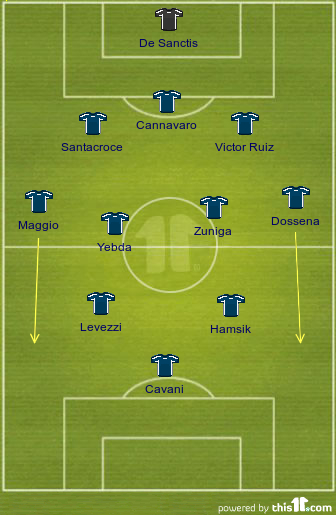
Evidence can also be found in Spain’s La Liga. Villarreal have lined up 4-2-2-2 for the majority of the previous season under Juan Carlos Garrido, a formation that contains two holding midfielders, two central attacking midfielders and two strikers – an upside-down T-shape – whereas recently-crowned champions Barcelona’s fluid 4-1-2-3 contains one holder, two central attacking midfielders and then Lionel Messi in the false 9 role which involves him dropping into the central attacking midfield area, giving his side, in effect, four central midfielders.

SPL examples
The first example, and perhaps the inspiration for this article, was the formations Celtic manager Neil Lennon deployed during the 2-2 draw at Ibrox in February. Celtic began the match in a lopsided 4-5-1 with Kris Commons wide left and Scott Brown in his, now familiar, tucked-in right sided role. The formation, therefore, contained four central midfielders, with one natural winger further forward.

Rangers dominated the early stages and opened the scoring early on, forcing Lennon to switch things around. He subsequently moved Commons into a central position just off Gary Hooper in attack, giving Celtic, in effect, five central midfielders. The four deeper-lying midfielders – now fluid and interchanging – all held central positions and now relied on the full-backs to provide width. The switch saw Celtic dominate the midfield area.

Similar examples of the above include Rangers’ 5-4-1, which also contained a narrow midfield four, first seen in the 2-2 draw away to Sporting Lisbon in the Europa League - the key difference being that Rangers’ midfield tended to be more rigid. As well as this, Derek McInnes has been known to line up St. Johnstone with a fluid central midfield four, usually in the form of three out-and-out central midfielders and Liam Craig in a tucked-in left-sided role.
Colin Calderwood has favoured a 4-1-3-2 formation for the most part since taking over as Hibernian manager towards the end of last year. The 4-1-3-2 involves Victor Palsson sitting just ahead of the defence as a deep-lying playmaker and is usually accompanied by three central midfielders just ahead of him, although there have been one or two occasions where one of the three is naturally a winger and thus has a tendency to drift wide.


In all of the above examples, the sides rely on their full-backs or wing-backs to advance and provide width. One example that does not necessarily involve pushing the full-backs on can be found with St. Mirren. Danny Lennon set his side up in a 4-3-2-1, or Christmas tree formation, during a recent trip to Ibrox which contained two attacking midfielders – Paul McGowan and Aaron Mooy- just ahead of three more industrious central midfielders – Paddy Cregg, Jim Goodwin and Steven Thomson – giving them five players in central midfield positions. The tactic worked for the most part as St. Mirren reduced the home side to few clear-cut chances and in the end narrowly lost the match to a second half Steven Whittaker penalty.
Drifting wingers
Evidence of sides packing the midfield area can also be found with a few clubs who tend to field players as a drifting winger or winger-cum-second-striker, that is, a player who starts in a wide position but who has a tendency, sometimes a compulsion, to drift into central areas. Perhaps the player in the SPL to play this role to the greatest effect is Steven Naismith of Rangers, although he usually executes this as part of a 4-4-2, giving Rangers a third central midfielder.
We would have to look to Scotland’s recent victory over Wales to find an example of three central midfielders being given extra help in that area by Naismith as a drifting winger. It is notable that Naismith, and Scotland as a whole, were not nearly as effective when Naismith was deployed as a second striker behind Kenny Miller in the following match against the Republic of Ireland.
Where the drifting wingers have caused sides to have, in effect, more than three central midfield players can be found in the following examples. Even though we have already discussed Celtic above, the formation mentioned was pretty much a one off as Lennon seemed to favour a two-striker formation most of the time. This did not detract from his desire to pack the midfield, however. For the second half of the season, Lennon’s most used formation was a lopsided 4-4-2. The starting positions included two holders – for example, Joe Ledley and Beram Kayal – with Scott Brown again in a tucked-in, right-sided role and Kris Commons on the left wing and more advanced. Commons, however, would often drift inside to central areas to collect the ball and link play between the Celtic midfield and attack. The movement of Commons meant that at many points during matches, Celtic had four players in central midfield positions.

At one point later in the season it appeared that Celtic were moving towards more of a 4-2-2-2, bearing some similarities to that of Villarreal mentioned earlier, with Brown slightly more advanced than usual and Commons pretty much as a central attacking midfielder. However, this formation didn’t last long and Lennon soon reverted back to the lopsided 4-4-2

Once Danny Swanson and Craig Conway returned from injury, Peter Houston was able to revert his Dundee United side back to his favoured 4-5-1-cum-4-3-3 formation with a V-shaped midfield. In this set up, Swanson is pretty much given free reign to drift all over the park. He will occasionally pop up on the opposite wing but spends a lot of time coming inside to occupy the area behind David Goodwillie and sometimes even drops as deep as the centre circle to collect the ball and start off attacks. It is also worth noting that Houston has also been willing to switch to a Christmas tree formation during matches, in effect, giving his side five central midfielders.

David Obua did something similar in Hearts’ 4-0 defeat to Rangers last month, albeit from a deeper starting position. It seems from the above that even though the starting positions of most sides suggests X amount of midfielders, a growing number of managers are instructing one of their wide players to either play a tucked in role, in other words a halfway house between wide and a central midfielder, or else as a drifting winger in order to give their side more bodies in the centre of the pitch while retaining some sort of width from midfield.
Reasons
One reason for the loading of central midfield areas has already been alluded to. This area of the pitch is often of paramount importance as winning the midfield battle is frequently the difference between victory and defeat. Having an extra man in the centre of midfield gives a side more chance of dominating possession and this is one of the reasons why 4-4-2, in its traditional form, has largely disappeared. The move away from 4-4-2 to two band formations has ultimately been aided by the liberalisation of the offside law which creates more space in central midfield areas and this, naturally, leads to more players being positioned where there is more space.
Furthermore, squeezing more players into central midfield positions has a positive effect on both the defensive and attacking capabilities of the side. Not only do the two or three holding midfielders offer their defence more protection, meaning that it is easier to win the ball, but when the ball is eventually won there are more passing options around the player in possession.
One further reason, related to the point in the previous paragraph, regards the apparent rise of strikerless formations in recent years. Craig Levein was, perhaps justifiably, lambasted for experimenting with a 4-6-0 in a Euro 2012 qualifier last year although a number of top teams have effectively employed such a tactic, most notably Barcelona, Manchester United and Roma. One of the thoughts behind this, which is related to our more general point that sides are deploying more central midfielders, is that once the ball is won it is more effective – or from the perspective of the opposition, more difficult – to have midfielders running at and beyond defenders rather than having strikers pushed high up the pitch with their back to goal.
So even though there seems to be little or no examples of a side in the SPL that doesn’t line up in four bands, it seems now that there are many examples of the two midfield bands becoming increasingly populated, be it from fielding more actual central midfielders or else by deploying wingers or wide midfielders who drift inside. Overall it seems that packing the midfield, more specifically the centre of midfield, is on the rise although not in the traditional sense and not necessarily with the aim of moving towards more negative football.
Subscribe to:
Posts (Atom)