Showing posts with label 4-2-2-2. Show all posts

Wednesday, 8 June 2011

Packing the Midfield

A growing trend during the most recent SPL campaign was for sides to pack the centre of their midfield.  This is not to say that teams are now dropping one of their strikers in favour of another midfielder – this has been evident for many years now – rather, sides appear to be starting matches with a narrow midfield four or five.

To put the same point a different way, when 4-4-2 was the default formation, some sides would diverge and set up more defensively by dropping a striker for an extra midfielder, thus moving to a 4-5-1 which still contained two wide players.  What is increasingly common now, however, is that teams are setting up in such a way that their line up contains four, sometimes five, central midfielders across two bands.

Liberalisation of the offside law

Since the liberalisation of the offside law in 2005, most teams have reverted to holding a deeper defensive line in order to avoid being caught out by the pace of opposing strikers – this is evidenced by the fact that the number of offsides per match has actually fallen significantly in recent years.  Consequently, the effective playing area has been stretched, leading teams to split their midfield into two bands – one attacking and one defensive – hence the re-emergence of four-band formations.  Thus, it is no longer adequate to describe the majority of formations as 4-4-2, 4-5-1 or 4-3-3.  4-4-2 formations are more likely 4-4-1-1 or 4-1-3-2 or something similar; 4-5-1 is more accurately described as, say, 4-2-3-1 (the most popular formation at last year’s World Cup); whereas a more precise notation of 4-3-3 could be either 4-3-1-2 (the default formation in Serie A at the moment) or 4-1-2-3 (the formation used by Barcelona to great effect in recent years).

In each of these formations, there is at least three central midfielders – the 4-4-1-1 contains two holding and one central attacking midfielder, as does the 4-2-3-1, whereas the 4-1-3-2 contains four central midfielders, one deeper-lying than the other three, and the 4-3-2-1 has three holding midfielders and two attacking central midfielders.  Although these formations, many of which are lone-striker systems, may appear prima facie more defensive, there is no reason why any should be considered as such.  Formations are neutral, it is their implementation that gives them positive and negative characteristics.

Therefore, the title Packing the Midfield is intended to convey that some teams are now squeezing four or five central midfielders across two bands, rather than the more traditional use of the phrase which implied a defensive approach, i.e. when a manager decided to drop a striker in favour of another central midfielder with the intention of stifling the midfield area, thus restricting the opportunities of their opponents.

Evidence elsewhere

Before we proceed to the SPL, it is worth pointing out a few examples of formations with four or five central midfielders elsewhere in Europe.  The default 4-3-1-2 in Serie A has already been mentioned but even the sides in Italy that do not adopt this formation, most notably Napoli, still make sure there are plenty bodies in central areas.  Walter Mazzarri’s favoured formation this season has been 3-4-2-1.  Broken down, this formation contains three central defenders; two holding midfielders flanked by two wing-backs; two central attacking midfielders and one striker.  This gives the side four central midfielders.
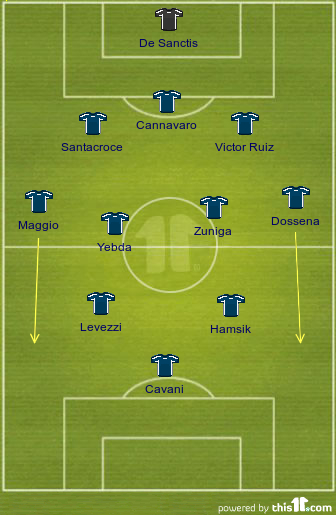

Evidence can also be found in Spain’s La Liga. Villarreal have lined up 4-2-2-2 for the majority of the previous season under Juan Carlos Garrido, a formation that contains two holding midfielders, two central attacking midfielders and two strikers – an upside-down T-shape – whereas recently-crowned champions Barcelona’s fluid 4-1-2-3 contains one holder, two central attacking midfielders and then Lionel Messi in the false 9 role which involves him dropping into the central attacking midfield area, giving his side, in effect, four central midfielders.


SPL examples

The first example, and perhaps the inspiration for this article, was the formations Celtic manager Neil Lennon deployed during the 2-2 draw at Ibrox in February.  Celtic began the match in a lopsided 4-5-1 with Kris Commons wide left and Scott Brown in his, now familiar, tucked-in right sided role.  The formation, therefore, contained four central midfielders, with one natural winger further forward. 

Rangers dominated the early stages and opened the scoring early on, forcing Lennon to switch things around.  He subsequently moved Commons into a central position just off Gary Hooper in attack, giving Celtic, in effect, five central midfielders.  The four deeper-lying midfielders – now fluid and interchanging – all held central positions and now relied on the full-backs to provide width.  The switch saw Celtic dominate the midfield area.

Similar examples of the above include Rangers’ 5-4-1, which also contained a narrow midfield four, first seen in the 2-2 draw away to Sporting Lisbon in the Europa League - the key difference being that Rangers’ midfield tended to be more rigid.  As well as this, Derek McInnes has been known to line up St. Johnstone with a fluid central midfield four, usually in the form of three out-and-out central midfielders and Liam Craig in a tucked-in left-sided role.

Colin Calderwood has favoured a 4-1-3-2 formation for the most part since taking over as Hibernian manager towards the end of last year.  The 4-1-3-2 involves Victor Palsson sitting just ahead of the defence as a deep-lying playmaker and is usually accompanied by three central midfielders just ahead of him, although there have been one or two occasions where one of the three is naturally a winger and thus has a tendency to drift wide.

In all of the above examples, the sides rely on their full-backs or wing-backs to advance and provide width.  One example that does not necessarily involve pushing the full-backs on can be found with St. Mirren.  Danny Lennon set his side up in a 4-3-2-1, or Christmas tree formation, during a recent trip to Ibrox which contained two attacking midfielders – Paul McGowan and Aaron Mooy- just ahead of three more industrious central midfielders – Paddy Cregg, Jim Goodwin and Steven Thomson – giving them five players in central midfield positions.  The tactic worked for the most part as St. Mirren reduced the home side to few clear-cut chances and in the end narrowly lost the match to a second half Steven Whittaker penalty.

Drifting wingers

Evidence of sides packing the midfield area can also be found with a few clubs who tend to field players as a drifting winger or winger-cum-second-striker, that is, a player who starts in a wide position but who has a tendency, sometimes a compulsion, to drift into central areas.  Perhaps the player in the SPL to play this role to the greatest effect is Steven Naismith of Rangers, although he usually executes this as part of a 4-4-2, giving Rangers a third central midfielder.

We would have to look to Scotland’s recent victory over Wales to find an example of three central midfielders being given extra help in that area by Naismith as a drifting winger.  It is notable that Naismith, and Scotland as a whole, were not nearly as effective when Naismith was deployed as a second striker behind Kenny Miller in the following match against the Republic of Ireland.

Where the drifting wingers have caused sides to have, in effect, more than three central midfield players can be found in the following examples.  Even though we have already discussed Celtic above, the formation mentioned was pretty much a one off as Lennon seemed to favour a two-striker formation most of the time.  This did not detract from his desire to pack the midfield, however.  For the second half of the season, Lennon’s most used formation was a lopsided 4-4-2.  The starting positions included two holders – for example, Joe Ledley and Beram Kayal – with Scott Brown again in a tucked-in, right-sided role and Kris Commons on the left wing and more advanced.  Commons, however, would often drift inside to central areas to collect the ball and link play between the Celtic midfield and attack.  The movement of Commons meant that at many points during matches, Celtic had four players in central midfield positions.

At one point later in the season it appeared that Celtic were moving towards more of a 4-2-2-2, bearing some similarities to that of Villarreal mentioned earlier, with Brown slightly more advanced than usual and Commons pretty much as a central attacking midfielder.  However, this formation didn’t last long and Lennon soon reverted back to the lopsided 4-4-2

Once Danny Swanson and Craig Conway returned from injury, Peter Houston was able to revert his Dundee United side back to his favoured 4-5-1-cum-4-3-3 formation with a V-shaped midfield.  In this set up, Swanson is pretty much given free reign to drift all over the park.  He will occasionally pop up on the opposite wing but spends a lot of time coming inside to occupy the area behind David Goodwillie and sometimes even drops as deep as the centre circle to collect the ball and start off attacks.  It is also worth noting that Houston has also been willing to switch to a Christmas tree formation during matches, in effect, giving his side five central midfielders.

David Obua did something similar in Hearts’ 4-0 defeat to Rangers last month, albeit from a deeper starting position.  It seems from the above that even though the starting positions of most sides suggests X amount of midfielders, a growing number of managers are instructing one of their wide players to either play a tucked in role, in other words a halfway house between wide and a central midfielder, or else as a drifting winger in order to give their side more bodies in the centre of the pitch while retaining some sort of width from midfield.

Reasons

One reason for the loading of central midfield areas has already been alluded to.  This area of the pitch is often of paramount importance as winning the midfield battle is frequently the difference between victory and defeat.  Having an extra man in the centre of midfield gives a side more chance of dominating possession and this is one of the reasons why 4-4-2, in its traditional form, has largely disappeared.  The move away from 4-4-2 to two band formations has ultimately been aided by the liberalisation of the offside law which creates more space in central midfield areas and this, naturally, leads to more players being positioned where there is more space.

Furthermore, squeezing more players into central midfield positions has a positive effect on both the defensive and attacking capabilities of the side.  Not only do the two or three holding midfielders offer their defence more protection, meaning that it is easier to win the ball, but when the ball is eventually won there are more passing options around the player in possession. 

One further reason, related to the point in the previous paragraph, regards the apparent rise of strikerless formations in recent years.  Craig Levein was, perhaps justifiably, lambasted for experimenting with a 4-6-0 in a Euro 2012 qualifier last year although a number of top teams have effectively employed such a tactic, most notably Barcelona, Manchester United and Roma.  One of the thoughts behind this, which is related to our more general point that sides are deploying more central midfielders, is that once the ball is won it is more effective – or from the perspective of the opposition, more difficult – to have midfielders running at and beyond defenders rather than having strikers pushed high up the pitch with their back to goal.

So even though there seems to be little or no examples of a side in the SPL that doesn’t line up in four bands, it seems now that there are many examples of the two midfield bands becoming increasingly populated, be it from fielding more actual central midfielders or else by deploying wingers or wide midfielders who drift inside.  Overall it seems that packing the midfield, more specifically the centre of midfield, is on the rise although not in the traditional sense and not necessarily with the aim of moving towards more negative football.

Monday, 21 March 2011

League Cup Final: Celtic 1 Rangers 2 AET


Rangers edged a hectic cup final to take the first silverware of the season.  The key to their victory was preventing Celtic from playing to their usual standard which, contrary to what many predicted, came from a good balance of attacking and defending along with some excellent pressing.

Kyle Bartley was ruled out because of an injury picked up against PSV on Thursday and Ricky Foster was cup-tied so Walter Smith brought in Steven Naismith and Nikica Jelavic and lined his side up 4-4-1-1/4-2-3-1, depending on whether in possession or not.  The switch from a five to a four-man defence was necessary due to the injury to Bartley, however, it could be argued that the more enterprising approach would have transpired regardless.

Celtic replaced Glenn Loovens with Thomas Rogne and Mark Wilson returned from suspension, as did Scott Brown, and they started ahead of Efrain Juarez and Ki Sung-Yeung.  Throughout the match they switched between their lopsided 4-4-2 and 4-2-2-2 but too many underperformances from too many players meant they failed to hit the same heights as they have done in recent months.


Rangers' more attacking approach

The opening stages were open and played at an incredible pace.  It is unclear whether Rangers’ more enterprising strategy was influenced by their second half performance on Thursday or because this was a cup final but either way they stopped Celtic’s key dangermen from playing to their usual level.

Celtic’s midfield began narrow with Brown and Kris Commons playing just ahead of Beram Kayal and Joe Ledley.   Usually the width is provided by Mark Wilson and Emilio Izaguirre but with Rangers playing with two advanced wide midfielders, the Celtic full-backs found themselves pinned back for much of the match.

When they did attempt to get forward, Rangers were quick to double up on them and they rarely found themselves in possession in areas where they could do damage.  Rangers’ defensive performance was based on their full-backs staying in position, rather than pushing on, and a fantastic first half performance from Maurice Edu who consistently broke up Celtic attacks and offered terrific protection to his defence.  He and Steven Davis both played relatively deep when in possession and the Northern Ireland international was able to start off a number of attacks.

As well as this, Rangers pressed higher than they have done in Old Firm matches this season and, even though he didn’t cause many problems with the ball, Naismith denied Kayal and Ledley the time on the ball they would have liked by playing in the area the two were operating in.

Rangers’ strategy while in possession was to play quick and direct passes, whether long towards Jelavic or else wide to Greg Wylde or Kyle Lafferty.

The opportunity for the opening goal came from a long punt up-field from Neil Alexander.  Joe Ledley failed to control Charlie Mulgrew’s defensive header and this allowed Davis to collect the ball and cut inside.  The Celtic defence dropped deeper and deeper as his run progressed and they allowed him slip the ball into the corner of the net.

Celtic responded quickly and were back on level terms within eight minutes.  All their attacks in the first half had come down the left-hand side, with Commons pulling wide more often than he has in recent matches and it was from this side that their equaliser came.  After taking a throw-in in an attacking area, Emilio Izaguirre received the ball back from Commons and created half a yard of space for himself before whipping in a cross that was flicked on by Georgios Samaras and headed into the net by Ledley.

Even though Rangers edged the first half, at least on the amount of chances created, Celtic’s passing was slicker when they did enjoy spells of possession and they arguably created the best chance when Brown headed wide unchallenged.

Second half – Celtic’s substitutes fail to inspire

Rangers switched to a 4-4-2 at the start of the second half with Lafferty joining Jelavic in attack and Naismith moving wide right.  They continued to get the ball wide but now had two tall strikers to aim for.  Even though Lafferty’s position was as a striker, he continued the crucial role that Naismith had effectively carried out in the first half, dropping deep and closing down Kayal and Ledley whenever they received the ball.

With sixty-five minutes played Celtic withdrew Brown for Ki, Commons moved over to the right and Ledley moved left.  Their midfield was now a bit flatter than it had been previously, however, the changes failed to give Celtic any advantage.  Ki can usually dictate, even when not afforded much space, but he failed to get on the ball a great deal.  Ledley and Commons were also both very quiet in the second half.

The final twenty-five minutes of the ninety were very stop-start and Rangers were forced to reshuffle their defence when Madjid Bougherra hobbled off injured.  Kyle Hutton replaced him with Edu moving to right-back and Steven Whittaker into central defence.  Despite their makeshift back four, Rangers continued to prevent Celtic from creating many opportunities.

Weiss introduction and Jelavic goal seals it in extra-time

Just before the ninety minutes expired, Vladimir Weiss took to the field in place of Lafferty and sat just off Jelavic as Rangers returned to the formation they started the match with.  The Slovakian’s pace was proving to be a handful for the tired legs of Celtic and he gave his side a valuable outlet during counter attacks as well as drawing a few fouls.  It is worth noting that Celtic turned to the tricky yet slow Paddy McCourt for some inspiration towards the end of the first period of extra time but he made little impact.


One of the more debateable fouls on Weiss led to the winning goal.  Weiss took the free kick quickly, sending Jelavic through as the Celtic defence reacted slowly, and the Croatian striker’s finish spun in off the post.

Not only did Weiss have a major influence on the match up to and for the winning goal, he was able to retain possession effectively afterwards which relieved the pressure on the Rangers’ defence.  The value of Weiss’s pace at such a time in the match was summed up when he outpaced the usually quick but tiring Izaguirre, which saw the Celtic full-back sent off for a professional foul. 

Conclusion 

Whether Celtic were unprepared for Rangers’ willingness to attack or whether they just were not good enough on the day to cope is unclear.  Either way Rangers edged a very competitive contest.  As was evidenced in their 2-0 defeat to Motherwell last month, the key to stopping Celtic is to prevent their full-backs from advancing.  Rangers fielded two attacking wide players throughout, who not only pinned them back by playing high up the pitch, but also tracked back and denied them possession in dangerous areas.

One other key factor to the Rangers victory was the emergence of Weiss from the bench.  He provided the assist for the goal but, more than this, he also had pace and directness when running with the ball that turned the game Rangers’ way when the game became stretched.

Celtic weren’t terrible but too many players underperformed.  Commons, Hooper, Kayal, Ledley and Brown were all quieter than usual whereas their Rangers counterparts won their individual battles and contributed to a deserved cup win.


Friday, 18 March 2011

League Cup Final Preview

*This article originally appeared in the online League Cup Final Preview Magazine. Please click the embedded link to see and/or download the magazine in full.


Team News

With Daniel Majstorovic ruled out for up to eight weeks, manager Neil Lennon may opt for the experience of Glenn Loovens over Thomas Rogne.  Georgios Samaras doesn’t get many starts for Celtic these days but has started in the last three Old Firm matches, meaning he will likely form a front two with Gary Hooper in attack.  Beram Kayal, Kris Commons and Scott Brown, who returns from suspension, will form the midfield along with either Ki Sung-Yeung or Joe Ledley.  It will be interesting to see whether Lennon decides to go with playmaker Ki, who can dictate the tempo, or whether he predicts a tough midfield battle and favours the more industrious Ledley.  Ledley may just edge it due to his brace against Inverness on Wednesday but either way Celtic should begin with their lopsided 4-4-2 which over the last month has evolved into more of a 4-2-2-2, but more on that below.

For Rangers, Steven Naismith is back from injury but may not be ready to start.  Against Kilmarnock on Sunday, Walter Smith lined-up Rangers in a 5-3-2/3-5-2 formation with Diouf just off Jelavic in attack, but has favoured 5-4-1 against better opposition.  Bougherra, Weir and Bartley will no doubt form the back three with Ricky Foster and Sasa Papac at wing-back.  Smith must then chose between the two formations.  Given Diouf’s tendency to drift away from his starting position, and the way Izaguirre exploited this when Celtic ran out 3-0 winners last month, Smith has a decision to make regarding how he fits the temperamental Senegalese forward into his line-up, if at all.


Celtic’s evolving 4-4-2

In that match, Celtic were able to play 4-4-2 without finding themselves overmanned in the centre of the pitch.  This was due to Scott Brown playing a more tucked-in right–sided midfield role, effectively giving them a central midfield three, with Commons wider and more advanced in a lopsided shape.

Their last three matches, however, have seen Brown slightly more advanced and Commons playing narrower.  This has made their formation resemble Villarreal’s 4-2-2-2, with two holding midfielders and two tucked-in wingers (although in Celtic’s case, one attacking midfielder and one tucked-in winger).

With the liberalisation of the offside law in 2005, which has seen the amount of offsides per match drop dramatically, high defensive lines are used less regularly meaning that games have become more stretched, leaving more space in the centre of the pitch.  Most teams have reacted to this by introducing ‘four band’ formations – for instance, 4-2-3-1, the predominant formation at last year’s World Cup, as opposed to 4-4-2 or 4-3-3 – splitting their midfield into two parts.  Neil Lennon’s 4-2-2-2 allows for this fourth band while retaining a 4-4-2 shape of sorts.  This means he can field two, as opposed to one, strikers against the three centre-backs of Rangers.

The 4-2-2-2 obviously lacks width in the midfield but as is now the trademark of Lennon’s Celtic, the full-backs habitually scurry up and down the wings, play as wingers for large parts of matches and sometimes even find themselves in the opposition penalty area.  For example, Celtic’s goal in their latest victory over Rangers involved a cross from Izaguirre that was finished, eventually, by Wilson.  Scott Brown’s goal came about in a similar manner when he equalised in the 2-2 draw at Ibrox last month.

With a few exceptions, Celtic’s team more or less picks itself.  What is less predictable is how Lennon will approach the match.  It will be interesting to see whether Celtic come firing out of the blocks or whether they’ll, knowing that Rangers will almost certainly get plenty men behind the ball and keep it tight early on, be patient enough to enjoy long spells of possession and try to work openings without forcing them.

One thing is for sure, Lennon is never afraid to change his system or his strategy early on when things aren’t going his way.  Against Hamilton two weeks ago he switched to a 4-3-3 midway through the first half and in the 2-2 draw with Rangers, he changed the position of several players with less than fifteen minutes played.

Key player – Scott Brown

One of the other key factors to the success of Celtic recently has been the revival of Scott Brown.  In January, Craig Fowler criticised the ex-Hibernian midfielder on The Terrace Scottish Football Podcast website for failing to sustain his form after his £4.5m transfer.  This can, at least partly, be explained by the majority of his time at Celtic Park being served as one half of a central midfield two.  Due to the stretching of the game mentioned earlier, midfielders can no longer play the box-to-box role as effectively.  This has caused most midifelders to adopt a more specialised role as either deep-lying or attacking.  It seems that his lack of form was as much down to the type of 4-4-2 employed by Celtic during most of his spell there as Brown’s inability to ‘specialise’ himself adequately.  Recently though, Lennon has tweaked his formation and allowed Brown to become more specialised.  He has now hit form as one of the attacking midfielders, knowing that the likes of Kayal provide an anchor in midfield that lets him get at opposition defences.

Rangers have more attacking options now

With a number of key players returning from injury, Walter Smith now has more attacking options at his disposal.  The five-man defence will line-up as usual but it is the midfield and attack where Rangers suddenly have competition for places.  In the attacking areas, Smith now has Jelavic, Diouf, Lafferty, Naismith, Weiss and Healy to choose from.

Nikica Jelavic will lead the line but then it would appear that Smith has four options regarding the set-up of his midfield.  Option one is of fielding two deep-lying central midfielders flanked by two wingers can be dismissed out-of-hand.  Smith attempted something similar in the 3-0 defeat at Celtic Park, albeit with Kyle Bartley as a defensive midfielder rather than centre-back, and found his side severely exposed down the wings.  He will no doubt avoid this given the threat of Izaguirre and Wilson from full-back.

The second option would be to again play four across the midfield but instead play a winger on one side and a more defensive-minded midfielder on the other.  For instance, Diouf on the left with Steven Whittaker tracking Izaguirre’s runs and providing protection and cover to Ricky Foster.  This would allow Rangers’ deep-lying central midfielders to match up man-for-man against Commons and Brown but would leave space for Kayal and Ki/Ledley.  In such a midfield four Diouf, if selected, would be the main source of support for Jelavic but has shown his inability to put in a disciplined defensive performance and his lack of tracking back would afford the central midfield two of Celtic the time and space to dictate.

Option three is a variant on option two and, therefore, falls foul of the same problems.  Considering this is a cup final, Rangers may ditch their ultra-defensive approach, knowing that gambling on penalties may be too risky, and be slightly more enterprising in their approach.  The formation would involve a deep-lying, three-man central midfield - most likely Davis, Edu and Whittaker – with Diouf or Naismith just off Jelavic but with the freedom to roam.  This option would allow the central midfield to help out their wing-backs in tracking Wilson and Izaguirre but in turn would leave gaps in the centre of the pitch for Commons and Brown to exploit.  A knock on effect of this is for one of the central defenders to step out, leaving space in-behind which could be dangerous.

Finally, there is the ultra-defensive approach preferred in the previous Old Firm and in most European matches this season that involves a bank of four relatively defensive midfielders in front of the back five, although one, usually the left-sided midfielder, pushes on more than the others.  This may very well be the set-up Smith opts for, at least in the early stages of the match, as it stifles the central areas that Celtic’s front four operate in while also providing scope for doubling up on their troublesome full-backs.  This would again allow Celtic’s central midfield two time and space but would make it much more difficult for them to work openings.  The strategy may then be to keep the score at 0-0, introduce the likes of Weiss and Naismith as the match progress and Celtic become tired, knowing that they are the type of player that can create a yard of space and hurt opposition defences.

Key player – Madjid Bougherra
 
A recent article by Jude Ellery on Defensive Minded noted that Chelsea’s signing of David Luiz marked the revival of the libero, an attack-minded defender, but under a different guise in modern times.  Whereas during the eighties and nineties the libero was a sweeper who would bring the ball out from defence and start off attacks, the more modern role is almost invariably a centre-back doing the same.   As well as a strong defensive presence, an attacking option is something Bougherra has offered during his time at Rangers, although less so this year due to the absence of Lee McCulloch who would usually sit in front of the Rangers defence and slot in seamlessly when required.

Bougherra could often be found playing one-twos around the halfway line and providing overlaps on the right wing.  There was recent evidence of this coming back into Bougherra’s game in Rangers’ match against Kilmarnock last week, and in a 5-4-1, when required, he may be able to revive his meandering runs more often, knowing that he has two centre-backs and ample cover from the midfield.

Conclusion

No matter how each team line up, the respective strategies, initially at least, will be for Rangers to keep it tight and for Celtic dominate possession.  Whether Lennon instructs his side to heap pressure on Rangers early on or else remain patient will be interesting to see, but whatever it is, we have seen in the past that he is not afraid to switch shape early on in matches if the initial tactics are not working.

Rangers will get plenty men behind the ball and defend for the opening stages of the match.  The main question will be whether this executed with a bank of four disciplined midfielders or else three such midfielders with one deployed in a more liberated role.  Smith then has options from the bench, something lacking in recent weeks, that can force openings and create opportunities when the game wears on and becomes stretched.

*Since writing this article it has come to light that Bartley and Lafferty will miss the match due to injury, in which case Rangers will be influenced by their second half performance against PSV and probably include Kyle Hutton as a defensive midfielder in a 4-5-1 formation.  Another option would be to reatin the 5-4-1 and move Saca Papac into the centre of defence.  This would mean Steven Whittaker taking up the left wing-back role and Hutton coming into midfield.  The injury to Lafferty means that Steven Naismith will almost certainly start the match.

Wednesday, 16 March 2011

Loss of Kyle shows need for new formation


A few months ago, Hearts sat in a position that lead some to speculate whether or not they could mount a serious title challenge.  A run of eleven matches without defeat, including ten wins and eight clean sheets, saw them move well clear of Kilmarnock in fourth and placed them within touching distance of the Old Firm.

Towards the end of that fantastic run, Hearts lost striker Kevin Kyle to injury.  Even though not the most prolific – five of his seven SPL goals have come from the penalty spot – he was a vital part of the success of the 4-2-3-1 system that Jim Jefferies has employed for the majority of the current season.  Since then, Hearts have struggled to find an adequate replacement among their squad and the word coming out of Tynecastle now is that the Scotland international may miss the rest of the season.  This poses the question, has the time come for Jefferies to adopt a new formation?

For the opening ten matches of the current SPL campaign, Jefferies chose to line-up Hearts in an orthodox 4-4-2 but after some indifferent form, culminating in a 3-0 defeat at home to Kilmarnock, decided to ditch the formation in favour of something more modern.  For the subsequent match at Easter Road, Jefferies switched to a 4-2-3-1, the predominant formation at last year’s World Cup.


In that match, Kyle was deployed as the lone striker, with Stephen Elliott and David Templeton either side and Rudi Skacel the more advanced of a midfield three.  The shape included two holding midfielders, one to break up the opposition play - Adrian Mrowiec - and a ball player with fewer defensive responsibilities but who was still required to graft - Ian Black.  This base, combined with a strong defensive unit, gave the ‘3’ in the 4-2-3-1 the licence to support Kyle in attack.


Even though Jefferies likes his sides to play passing football where possible, he is pragmatic enough to know that the rigours of the SPL, not to mention the temperamental condition of some of the playing surfaces, makes this method undesirable at times.  Thus, Jefferies is not afraid to instruct his side to switch to a more direct style, knowing that Kyle possesses the ability to hold the ball up in advanced areas.

After the recent draw away to Aberdeen, Jefferies admitted that “Aberdeen adapted to the type of surface” and that “this was a day for Kevin Kyle”, which was his way of conceding that he would have liked the option of hitting long, direct passes towards a target man in order for him to hold the ball up and bring midfield runners into play.  He wins most of the aerial and physical battles he faces and, further, is able to occupy two centre backs in a way that negates the numerical disadvantage Hearts have in this area of the pitch.  This was the key to Jefferies’s system during the height of its success.

Though brought to the club under the pretence that he could potentially be the twenty-goal-a-season striker that Hearts have sorely lacked for several years, his main attribute has been to hold up the ball and bring the likes of Skacel, and Templeton into play.  A perfect example of this came in Hearts’ 2-0 victory at Easter Road on New Year’s Day, a match in which Kyle consistently pulled central defenders out of position, held the ball up effectively and created opportunities for his teammates.

Hearts have other options in these attacking midfield positions, not least Stephen Elliott who has spent a large portion of the season on the right wing, yet often drifts inside during matches to form a classic big-man-little-man partnership with Kyle in attack.  The best of Elliott has been from this position and the reason his form has dipped since Kyle’s absence is not so much that he has played as the lone striker, a role that doesn’t suit him, but more that he has not had Kyle alongside him to feed off.

It is not just Stephen Elliot that has failed to fill the space vacated by Kyle.  Midfielder David Obua was initially chosen, solely on the height he possesses, but was predictably out-muscled by Frazer Wright and Mohammed Sissoko against Kilmarnock at Rugby Park.  The following match against Rangers saw another midfielder, this time Ryan Stevenson, chosen.  Again height was a factor but Jefferies this time hoped that his bulky frame could help in replicating Kyle.  Even though Stevenson scored in this particular fixture, he struggled to get involved in the match and it wasn’t until Jefferies moved him back into the midfield of a 4-2-2-2 formation that he netted the winner.


Gary Glen and Callum Elliot are two others who have tried their luck in the position.  In terms of attributes, Callum Elliot is perhaps the most suited of all possible replacements but has failed to regain his early season form in his recent handful of appearances.

Injuries in other areas of the field, such as central midfield and full-back, have no doubt also contributed to the recent dip in form and it could also be argued that Hearts have become predicable in their strategy.  With Kyle missing, it is down to other key dangermen to score and create but teams have recently shown that doubling up on Templeton and man-marking Skacel out of the game makes the Jambos a far less potent attacking threat.

This point adds yet more weight to the argument that Jefferies should seek an alternative to his current system.  Even with all key players available, opposition managers soon begin to develop methods of countering the formations and strategies of in-form sides, especially given that it is possible for teams to face each other up to seven times a season.

A return to the standard British 4-4-2 is not desirable.  Not only was it unsuccessful when the current campaign was in its early stages, but also because the formation leaves a shortfall in midfield when lining-up against the likes of a 4-5-1, 4-3-3 or similar variant.  However, lacking an adequate replacement target man, Jefferies may now need to consider switching to a two-striker formation for the remainder of the season.

The narrow 4-2-2-2 that Jefferies switched to during the home win over Rangers earlier in the season is one option, as by removing the wingers it allows the team to play with two strikers but without leaving the side overmanned in the centre of the pitch.

Whatever Jefferies decides to do, he must come up with a way of compensating for the periodic absence of the injury-prone Kyle, not just for the current season but for seasons to come.