With the events of the last week, within which Ally McCoist was placed on gardening leave, it is Kenny McDowall who is now tasked with guiding this Rangers side through the remainder of a turbulent season.
If the Rangers supporters thought that an uninspiring appointment, albeit temporary, they would be just as underwhelmed when they saw the caretaker boss’s first team selection. McDowall was given the opportunity to put his own stamp on the current side. He could have changed the shape and introduced some players that found appearances difficult to come by under McCoist. Instead he picked exactly the same personnel in exactly the same archaic formation as has become the norm at Rangers this season.
Nicky Clark partnered Kenny Miller in the attack of a 4-4-2, which saw the centre of their midfield drowned by the 4-3-1-2 of Hibernian. With Dominique Malonga and Jason Cummings taking turns to drop deep, this meant even more of a mismatch in the centre of midfield and the problem was highlighted early in the match when both Nicky Law and Ian Black were caught out up the pitch as Hibs countered.
The shape of the Hibernian midfield and the advanced nature of their full-backs meant that they contained sufficient width when attacking – evidenced by the performances of David Gray and Lewis Stevenson – and enough cover when defending.
Much of the positivity on the progression of Stubbs’s side has been focused on the performances of Scott Allan and today was no different. Due to Hibs' numerical advantage, he was free to dictate play for most of the match and was involved in all four goals. For the opener, Allan burst forward off the ball and dragged Stevie Smith into the centre to pick him up. This created space for David Gray to collect the ball and fire Hibs ahead after 8 minutes.
For the second goal, Smith was in position when Allan collected the ball but failed to get close enough to stop the cross. Allan’s ball found Craig, who volleyed back for Cummings to tap into an open goal. Allan then capped off a majestic performance with two clever assists in the second half to give Hibernian a 4-0 victory.
It should not be surprising to see Hibs dominate this match as Alan Stubbs has won the tactical battle in many of the big matches this season. He was dominating McCoist – changing his formation at the correct time – before Danny Handling was sent off in the Petrofac Training Cup at the start of the season and, much like this match, he blitzed Rangers in the first half of the previous league meeting between the sides.
Furthermore, he more than matched Hearts for large parts of the opening Edinburgh Derby of the season and, but for an injury-time wonder strike, was seconds away from victory in the second at Easter Road.
Rangers, by contrast, have been found wanting in most of the big matches in the Championship this season. Even in the matches they have edged the initial tactical battle – the recent performance at Tynecastle, for instance – they have still gone on to lose the match. In four Championship matches versus Hearts and Hibs this season, Rangers have lost all four.
And there is nothing in the pre- or post-match interviews of McDowall, nor from the performance of the team, to suggest that he is the man to inject some modernity into the Rangers tactics. It is rather telling by his comments after the match, in which he revealed that he is being “told to carry on”, that he is either unwilling or unable to take charge of this Rangers side.
McCoist liked his team to knock the ball into the channels and work it down the wings, always looking for the overlap from the full-backs and that is exactly what we got from McDowall in this match. If further confirmation was needed that working the ball wide and crossing the ball as often as possible hasn't worked, you only have to look at the full-time statistics: Rangers had 7 attempts with 1 on target - Hibernian had the same amount of efforts but hit the target 5 times - and had 8 corners to Hibernian’s 0.
One of the reasons most of the Rangers play was focused down the wings was to avoid the congested central areas in which they were outnumbered. It appeared that McDowall had identified this when Kyle Hutton was stripped and ready to come on after 34 minutes. Unfortunately for Rangers, he hadn't and Hutton was nothing more than a like-for-like replacement for Ian Black before the former Hearts man collected a second yellow card. The change may have improved the Rangers performance for a short period, but the same issues remained.
Even the half-time substitution made little sense. Kris Boyd was introduced for Fraser Aird but instead of changing the shape of the side, Clark was moved to the right of midfield in the same formation that Rangers have played for about 37 years now.
It is perplexing that a qualified football coach, despite his lack of experience as a football manager, failed to notice or rectify the major tactical issue his side faced in the match. Rangers had two strikers on the pitch for the whole of the match, yet their manager failed to notice that having two strikers is useless if you cannot win the ball when out of possession or else supply them when in possession.
Showing posts with label 4-4-2. Show all posts
Showing posts with label 4-4-2. Show all posts
Saturday, 27 December 2014


Wednesday, 8 June 2011
Packing the Midfield
A growing trend during the most recent SPL campaign was for sides to pack the centre of their midfield. This is not to say that teams are now dropping one of their strikers in favour of another midfielder – this has been evident for many years now – rather, sides appear to be starting matches with a narrow midfield four or five.
To put the same point a different way, when 4-4-2 was the default formation, some sides would diverge and set up more defensively by dropping a striker for an extra midfielder, thus moving to a 4-5-1 which still contained two wide players. What is increasingly common now, however, is that teams are setting up in such a way that their line up contains four, sometimes five, central midfielders across two bands.
Liberalisation of the offside law
Since the liberalisation of the offside law in 2005, most teams have reverted to holding a deeper defensive line in order to avoid being caught out by the pace of opposing strikers – this is evidenced by the fact that the number of offsides per match has actually fallen significantly in recent years. Consequently, the effective playing area has been stretched, leading teams to split their midfield into two bands – one attacking and one defensive – hence the re-emergence of four-band formations. Thus, it is no longer adequate to describe the majority of formations as 4-4-2, 4-5-1 or 4-3-3. 4-4-2 formations are more likely 4-4-1-1 or 4-1-3-2 or something similar; 4-5-1 is more accurately described as, say, 4-2-3-1 (the most popular formation at last year’s World Cup); whereas a more precise notation of 4-3-3 could be either 4-3-1-2 (the default formation in Serie A at the moment) or 4-1-2-3 (the formation used by Barcelona to great effect in recent years).
In each of these formations, there is at least three central midfielders – the 4-4-1-1 contains two holding and one central attacking midfielder, as does the 4-2-3-1, whereas the 4-1-3-2 contains four central midfielders, one deeper-lying than the other three, and the 4-3-2-1 has three holding midfielders and two attacking central midfielders. Although these formations, many of which are lone-striker systems, may appear prima facie more defensive, there is no reason why any should be considered as such. Formations are neutral, it is their implementation that gives them positive and negative characteristics.
Therefore, the title Packing the Midfield is intended to convey that some teams are now squeezing four or five central midfielders across two bands, rather than the more traditional use of the phrase which implied a defensive approach, i.e. when a manager decided to drop a striker in favour of another central midfielder with the intention of stifling the midfield area, thus restricting the opportunities of their opponents.
Evidence elsewhere
Before we proceed to the SPL, it is worth pointing out a few examples of formations with four or five central midfielders elsewhere in Europe. The default 4-3-1-2 in Serie A has already been mentioned but even the sides in Italy that do not adopt this formation, most notably Napoli, still make sure there are plenty bodies in central areas. Walter Mazzarri’s favoured formation this season has been 3-4-2-1. Broken down, this formation contains three central defenders; two holding midfielders flanked by two wing-backs; two central attacking midfielders and one striker. This gives the side four central midfielders.
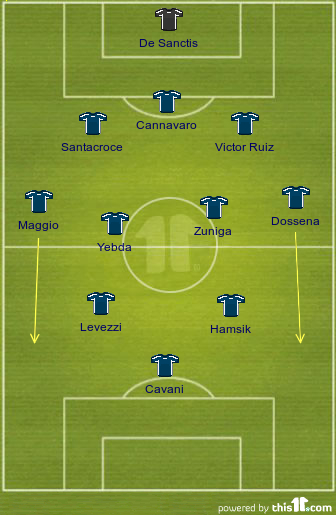
Evidence can also be found in Spain’s La Liga. Villarreal have lined up 4-2-2-2 for the majority of the previous season under Juan Carlos Garrido, a formation that contains two holding midfielders, two central attacking midfielders and two strikers – an upside-down T-shape – whereas recently-crowned champions Barcelona’s fluid 4-1-2-3 contains one holder, two central attacking midfielders and then Lionel Messi in the false 9 role which involves him dropping into the central attacking midfield area, giving his side, in effect, four central midfielders.

SPL examples
The first example, and perhaps the inspiration for this article, was the formations Celtic manager Neil Lennon deployed during the 2-2 draw at Ibrox in February. Celtic began the match in a lopsided 4-5-1 with Kris Commons wide left and Scott Brown in his, now familiar, tucked-in right sided role. The formation, therefore, contained four central midfielders, with one natural winger further forward.

Rangers dominated the early stages and opened the scoring early on, forcing Lennon to switch things around. He subsequently moved Commons into a central position just off Gary Hooper in attack, giving Celtic, in effect, five central midfielders. The four deeper-lying midfielders – now fluid and interchanging – all held central positions and now relied on the full-backs to provide width. The switch saw Celtic dominate the midfield area.

Similar examples of the above include Rangers’ 5-4-1, which also contained a narrow midfield four, first seen in the 2-2 draw away to Sporting Lisbon in the Europa League - the key difference being that Rangers’ midfield tended to be more rigid. As well as this, Derek McInnes has been known to line up St. Johnstone with a fluid central midfield four, usually in the form of three out-and-out central midfielders and Liam Craig in a tucked-in left-sided role.
Colin Calderwood has favoured a 4-1-3-2 formation for the most part since taking over as Hibernian manager towards the end of last year. The 4-1-3-2 involves Victor Palsson sitting just ahead of the defence as a deep-lying playmaker and is usually accompanied by three central midfielders just ahead of him, although there have been one or two occasions where one of the three is naturally a winger and thus has a tendency to drift wide.


In all of the above examples, the sides rely on their full-backs or wing-backs to advance and provide width. One example that does not necessarily involve pushing the full-backs on can be found with St. Mirren. Danny Lennon set his side up in a 4-3-2-1, or Christmas tree formation, during a recent trip to Ibrox which contained two attacking midfielders – Paul McGowan and Aaron Mooy- just ahead of three more industrious central midfielders – Paddy Cregg, Jim Goodwin and Steven Thomson – giving them five players in central midfield positions. The tactic worked for the most part as St. Mirren reduced the home side to few clear-cut chances and in the end narrowly lost the match to a second half Steven Whittaker penalty.
Drifting wingers
Evidence of sides packing the midfield area can also be found with a few clubs who tend to field players as a drifting winger or winger-cum-second-striker, that is, a player who starts in a wide position but who has a tendency, sometimes a compulsion, to drift into central areas. Perhaps the player in the SPL to play this role to the greatest effect is Steven Naismith of Rangers, although he usually executes this as part of a 4-4-2, giving Rangers a third central midfielder.
We would have to look to Scotland’s recent victory over Wales to find an example of three central midfielders being given extra help in that area by Naismith as a drifting winger. It is notable that Naismith, and Scotland as a whole, were not nearly as effective when Naismith was deployed as a second striker behind Kenny Miller in the following match against the Republic of Ireland.
Where the drifting wingers have caused sides to have, in effect, more than three central midfield players can be found in the following examples. Even though we have already discussed Celtic above, the formation mentioned was pretty much a one off as Lennon seemed to favour a two-striker formation most of the time. This did not detract from his desire to pack the midfield, however. For the second half of the season, Lennon’s most used formation was a lopsided 4-4-2. The starting positions included two holders – for example, Joe Ledley and Beram Kayal – with Scott Brown again in a tucked-in, right-sided role and Kris Commons on the left wing and more advanced. Commons, however, would often drift inside to central areas to collect the ball and link play between the Celtic midfield and attack. The movement of Commons meant that at many points during matches, Celtic had four players in central midfield positions.

At one point later in the season it appeared that Celtic were moving towards more of a 4-2-2-2, bearing some similarities to that of Villarreal mentioned earlier, with Brown slightly more advanced than usual and Commons pretty much as a central attacking midfielder. However, this formation didn’t last long and Lennon soon reverted back to the lopsided 4-4-2

Once Danny Swanson and Craig Conway returned from injury, Peter Houston was able to revert his Dundee United side back to his favoured 4-5-1-cum-4-3-3 formation with a V-shaped midfield. In this set up, Swanson is pretty much given free reign to drift all over the park. He will occasionally pop up on the opposite wing but spends a lot of time coming inside to occupy the area behind David Goodwillie and sometimes even drops as deep as the centre circle to collect the ball and start off attacks. It is also worth noting that Houston has also been willing to switch to a Christmas tree formation during matches, in effect, giving his side five central midfielders.
David Obua did something similar in Hearts’ 4-0 defeat to Rangers last month, albeit from a deeper starting position. It seems from the above that even though the starting positions of most sides suggests X amount of midfielders, a growing number of managers are instructing one of their wide players to either play a tucked in role, in other words a halfway house between wide and a central midfielder, or else as a drifting winger in order to give their side more bodies in the centre of the pitch while retaining some sort of width from midfield.
Reasons
One reason for the loading of central midfield areas has already been alluded to. This area of the pitch is often of paramount importance as winning the midfield battle is frequently the difference between victory and defeat. Having an extra man in the centre of midfield gives a side more chance of dominating possession and this is one of the reasons why 4-4-2, in its traditional form, has largely disappeared. The move away from 4-4-2 to two band formations has ultimately been aided by the liberalisation of the offside law which creates more space in central midfield areas and this, naturally, leads to more players being positioned where there is more space.
Furthermore, squeezing more players into central midfield positions has a positive effect on both the defensive and attacking capabilities of the side. Not only do the two or three holding midfielders offer their defence more protection, meaning that it is easier to win the ball, but when the ball is eventually won there are more passing options around the player in possession.
One further reason, related to the point in the previous paragraph, regards the apparent rise of strikerless formations in recent years. Craig Levein was, perhaps justifiably, lambasted for experimenting with a 4-6-0 in a Euro 2012 qualifier last year although a number of top teams have effectively employed such a tactic, most notably Barcelona, Manchester United and Roma. One of the thoughts behind this, which is related to our more general point that sides are deploying more central midfielders, is that once the ball is won it is more effective – or from the perspective of the opposition, more difficult – to have midfielders running at and beyond defenders rather than having strikers pushed high up the pitch with their back to goal.
So even though there seems to be little or no examples of a side in the SPL that doesn’t line up in four bands, it seems now that there are many examples of the two midfield bands becoming increasingly populated, be it from fielding more actual central midfielders or else by deploying wingers or wide midfielders who drift inside. Overall it seems that packing the midfield, more specifically the centre of midfield, is on the rise although not in the traditional sense and not necessarily with the aim of moving towards more negative football.
Tuesday, 3 May 2011
Tactical shorts: Celtic 4 Dundee United 1

Celtic responded to Rangers' emphatic win the previous day with a comfortable win of their own.
With Joe Ledley missing, Neil Lennon opted to move Scott Brown into a central role and go with two wingers. Kris Commons played his usual role of switching between wide and central positions with James Forrest more of an out-and-out winger. Commons began on the left but was moved to the right, with Forrest switching to the left, after less than ten minutes. The pair switched once again at the start of the second half. Antony Stokes was restored to the starting line up and was the more advanced of the front two with Gary Hooper in a deeper role than he is known for.
Dundee United were at full strength and began in their usual 4-5-1/4-3-3 formation with a fluid midfield five. They pushed their full-backs on and attempted to attack from the off, rather than soaking up pressure like most teams that visit Celtic Park do.
The match began with both sides displaying equal amounts of stray passes and quick, intricate periods of possession. After the first goal, which involved a shocking error from Garry Kenneth and some excellent link up play from Stokes and Hooper, Dundee United became impotent as an attacking threat and only began to threaten again when they conceded a second and introduced Johnny Russell from the bench.
Midfield battle
Celtic were outnumbered by three to two in the centre of the pitch but a few different reasons negated this. Firstly, Scott Brown and Beram Kayal put it excellent performances, especially in a defensive sense. The tenacity of the pair and their constant harrying meant that Dundee United struggled to work the ball through the centre of the pitch.
Secondly, Celtic’s strategy was to move the ball quickly to Forrest and Commons and push the full-backs on. With their height disadvantage in attack, they then focused on working the ball across the goal in the form of cut backs and low, driven crosses.
One final reason was that the positions of Commons and Hooper meant that, at times, Celtic did have a third man in the centre of the pitch.
Celtic’s full-backs
Relatedly, Mark Wilson and Emilio Izaguirre were back to their attacking best. In recent matches, Wilson has, through design or necessity, found himself staying back more often than not, while some sides have managed to lessen the threat of Izaguirre. On Sunday, however, both managed to get forward on a number of occasions, provide support to the attack and put in dangerous crosses.
This had the knock on effect of causing the Dundee United wingers, Danny Swanson and Craig Conway, to track back more often than they would have liked, leaving Daniel Majstorovic and Charlie Mulgrew to deal with the isolated David Goodwillie.
Substitutions
Both managers made substitutions that made an impact on the game. After going 2-0 down, Peter Houston replaced Prince Bauben and Danny Swanson with Jon Daly and Johnny Russell and moved to a 4-4-2.
Dundee United instantly improved which was evidenced when Russell cut inside from the right wing and struck the post with a left foot strike. Russell wasted another chance when he decided to go for goal rather than squaring it to Goodwillie for a tap-in. Russell eventually scored in injury time but by that time it was too late and his side were three goals behind.
Lennon responded to the Dundee United substitutions by introducing Ki Sung-Yeung for Forrest and moving Brown to his, now familiar, tucked-in right sided role in a lopsided 4-4-2. It was now Celtic who had the man advantage in the centre of the park and the presence of Ki meant that they were able to utilise possession better and slow the pace of the game down.
A further substitution on seventy-five minutes saw Shaun Maloney replace Hooper and take up a trequartista role. Again this helped Celtic retain possession with the added bonus of a third goal which Maloney provided the assist for.
One final substitution for Celtic saw Brown withdrawn to be replaced by Daryl Murphy. Murphy restored Celtic’s three goal advantage with a fine solo effort in the final minute of injury time.
Tuesday, 22 March 2011
St. Johnstone 1 Brechin 0
A game of little quality, that failed to live up to the heights of the initial tie, was comfortably won by St. Johnstone and takes them into the semi-final where they will face the winner of Motherwell versus Dundee United. Brechin rarely threatened and, predictably, looked a very tired side.
Derek McInnes recalled Alan Maybury to the side, dropping Graham Gartland, and started with Chris Millar in the centre of midfield ahead of Jamie Adams. One change for Brechin saw Gary Fusco brought in at the expense of Jamie Redman.

Jim Weir lined-up his side in an orthodox 4-4-2 with Rory McAllister and David McKenna in attack, although the pair were devoid of support from their midfield who sat behind the ball for most of the match. St. Johnstone also took to the field in a 4-4-2 although their midfield was very fluid throughout the first half, even if their passing was not. Liam Craig started on the left but would often drift inside and Chris Millar, the main creative spark for the home side, was free to roam all over the pitch.
First half
Brechin defended well for the most part, however, their only tactic going forward was to hit long balls towards McAllister, with McKenna running in-behind in the hope he could pick up any flick-ons. They were forced into an early change when right-back Paul McLean hobbled off in the eleventh minute to be replaced by David White.
Even though St. Johnstone attempted to pass the ball around they were also prone to aimless punts up-field. They created a number of chances early on, one of which forced Craig Nelson into a smart save and another which Craig should have finished after a low cross from Murray Davidson.
When they kept the ball on the ground, most of St Johnstone’s play was focused down the left through Craig, who looked to hit the strikers with early crosses. Other than this, St. Johnstone had a frustrating tendency to pile players up towards the edge of the Brechin box and hit the ball long and high towards them.
There was a period in the first half where Millar would drop almost in line with his centre-backs in order to receive the ball but his willingness to create from deep was ignored as St. Johnstone continued to hit the ball long.
Peter Enckleman was forced into an excellent save from a low Fusco strike with just over half an hour played and McAllister wasted a decent opportunity after a shocking error from Steven Anderson, but that was as about as good as it got for the visitors.
Brechin were made to rue those missed opportunities when Colin Samuel opened the scoring after thirty-six minutes. The ball broke to Davidson midway inside the opposing half and he sent a nicely weighted ball over the top of the Brechin defence. Samuel outmuscled Gerry McLaughlin and saw his first effort rebound off the centre-half. The ball then dropped to Samuel again and he fired across Nelson and inside the far post. It was a decent finish from the Trinidad and Tobago striker, however, the goalkeeper’s attempt at a save was less than impressive.
Second half
The restart saw Brechin immediately show intent to search for an equaliser and they spent a short spell in the St. Johnstone half. Nevertheless, they failed to create any chances and soon began to display signs of tiring. Craig Molloy and Neil Janczyk were at the heart of some nice, if short-lived, passing moves but again found themselves overrun by St. Johnstone’s more energetic midfield.
The midfield four of St. Johnstone was now a lot more rigid than it had been in the first half and they now looked to get the ball towards Danny Invincible more often than not, whether to feet so he could run at Brechin left-back Andrew Cook or else via long diagonal balls. The Australian managed to get the better of Cook on a few occasions but the resultant chances were wasted by his teammates. None more so than a terrible effort from McDonald which flew high over the bar but which, in fairness, bobbled slightly before he unleashed his strike.
The match petered out to a close with Brechin struggling to get McAllister and McKenna in possession in dangerous areas and St. Johnstone rarely threatening to add to their lead. The Perth side will now face Motherwell or Dundee United in the semi-final at Hampden and will have to tp their game significantly to have any chance of reaching their first ever Scottish Cup final.
Monday, 21 March 2011
League Cup Final: Celtic 1 Rangers 2 AET
Rangers edged a hectic cup final to take the first silverware of the season. The key to their victory was preventing Celtic from playing to their usual standard which, contrary to what many predicted, came from a good balance of attacking and defending along with some excellent pressing.
Kyle Bartley was ruled out because of an injury picked up against PSV on Thursday and Ricky Foster was cup-tied so Walter Smith brought in Steven Naismith and Nikica Jelavic and lined his side up 4-4-1-1/4-2-3-1, depending on whether in possession or not. The switch from a five to a four-man defence was necessary due to the injury to Bartley, however, it could be argued that the more enterprising approach would have transpired regardless.
Celtic replaced Glenn Loovens with Thomas Rogne and Mark Wilson returned from suspension, as did Scott Brown, and they started ahead of Efrain Juarez and Ki Sung-Yeung. Throughout the match they switched between their lopsided 4-4-2 and 4-2-2-2 but too many underperformances from too many players meant they failed to hit the same heights as they have done in recent months.

Rangers' more attacking approach
The opening stages were open and played at an incredible pace. It is unclear whether Rangers’ more enterprising strategy was influenced by their second half performance on Thursday or because this was a cup final but either way they stopped Celtic’s key dangermen from playing to their usual level.
Celtic’s midfield began narrow with Brown and Kris Commons playing just ahead of Beram Kayal and Joe Ledley. Usually the width is provided by Mark Wilson and Emilio Izaguirre but with Rangers playing with two advanced wide midfielders, the Celtic full-backs found themselves pinned back for much of the match.
When they did attempt to get forward, Rangers were quick to double up on them and they rarely found themselves in possession in areas where they could do damage. Rangers’ defensive performance was based on their full-backs staying in position, rather than pushing on, and a fantastic first half performance from Maurice Edu who consistently broke up Celtic attacks and offered terrific protection to his defence. He and Steven Davis both played relatively deep when in possession and the Northern Ireland international was able to start off a number of attacks.
As well as this, Rangers pressed higher than they have done in Old Firm matches this season and, even though he didn’t cause many problems with the ball, Naismith denied Kayal and Ledley the time on the ball they would have liked by playing in the area the two were operating in.
Rangers’ strategy while in possession was to play quick and direct passes, whether long towards Jelavic or else wide to Greg Wylde or Kyle Lafferty.
The opportunity for the opening goal came from a long punt up-field from Neil Alexander. Joe Ledley failed to control Charlie Mulgrew’s defensive header and this allowed Davis to collect the ball and cut inside. The Celtic defence dropped deeper and deeper as his run progressed and they allowed him slip the ball into the corner of the net.
Celtic responded quickly and were back on level terms within eight minutes. All their attacks in the first half had come down the left-hand side, with Commons pulling wide more often than he has in recent matches and it was from this side that their equaliser came. After taking a throw-in in an attacking area, Emilio Izaguirre received the ball back from Commons and created half a yard of space for himself before whipping in a cross that was flicked on by Georgios Samaras and headed into the net by Ledley.
Even though Rangers edged the first half, at least on the amount of chances created, Celtic’s passing was slicker when they did enjoy spells of possession and they arguably created the best chance when Brown headed wide unchallenged.
Second half – Celtic’s substitutes fail to inspire
Rangers switched to a 4-4-2 at the start of the second half with Lafferty joining Jelavic in attack and Naismith moving wide right. They continued to get the ball wide but now had two tall strikers to aim for. Even though Lafferty’s position was as a striker, he continued the crucial role that Naismith had effectively carried out in the first half, dropping deep and closing down Kayal and Ledley whenever they received the ball.
With sixty-five minutes played Celtic withdrew Brown for Ki, Commons moved over to the right and Ledley moved left. Their midfield was now a bit flatter than it had been previously, however, the changes failed to give Celtic any advantage. Ki can usually dictate, even when not afforded much space, but he failed to get on the ball a great deal. Ledley and Commons were also both very quiet in the second half.
The final twenty-five minutes of the ninety were very stop-start and Rangers were forced to reshuffle their defence when Madjid Bougherra hobbled off injured. Kyle Hutton replaced him with Edu moving to right-back and Steven Whittaker into central defence. Despite their makeshift back four, Rangers continued to prevent Celtic from creating many opportunities.
Weiss introduction and Jelavic goal seals it in extra-time
Just before the ninety minutes expired, Vladimir Weiss took to the field in place of Lafferty and sat just off Jelavic as Rangers returned to the formation they started the match with. The Slovakian’s pace was proving to be a handful for the tired legs of Celtic and he gave his side a valuable outlet during counter attacks as well as drawing a few fouls. It is worth noting that Celtic turned to the tricky yet slow Paddy McCourt for some inspiration towards the end of the first period of extra time but he made little impact.

One of the more debateable fouls on Weiss led to the winning goal. Weiss took the free kick quickly, sending Jelavic through as the Celtic defence reacted slowly, and the Croatian striker’s finish spun in off the post.
Not only did Weiss have a major influence on the match up to and for the winning goal, he was able to retain possession effectively afterwards which relieved the pressure on the Rangers’ defence. The value of Weiss’s pace at such a time in the match was summed up when he outpaced the usually quick but tiring Izaguirre, which saw the Celtic full-back sent off for a professional foul.
Conclusion
Whether Celtic were unprepared for Rangers’ willingness to attack or whether they just were not good enough on the day to cope is unclear. Either way Rangers edged a very competitive contest. As was evidenced in their 2-0 defeat to Motherwell last month, the key to stopping Celtic is to prevent their full-backs from advancing. Rangers fielded two attacking wide players throughout, who not only pinned them back by playing high up the pitch, but also tracked back and denied them possession in dangerous areas.
One other key factor to the Rangers victory was the emergence of Weiss from the bench. He provided the assist for the goal but, more than this, he also had pace and directness when running with the ball that turned the game Rangers’ way when the game became stretched.
Celtic weren’t terrible but too many players underperformed. Commons, Hooper, Kayal, Ledley and Brown were all quieter than usual whereas their Rangers counterparts won their individual battles and contributed to a deserved cup win.
Subscribe to:
Posts (Atom)